How to Calculate Symmetric Relations in Set Theory?

Click For Summary
To calculate symmetric relations on the set A = {1,2,3,4,5,6,7}, one must consider the symmetry about the main diagonal in a 7x7 table representation. A symmetric relation is determined by the pairs on and above the diagonal, with 7 diagonal positions and 21 positions above it. For four ordered pairs, the combinations include placing all on the diagonal, some on the diagonal with others above, or none on the diagonal with pairs above. Similarly, for five ordered pairs, various combinations of diagonal and above-diagonal placements are considered. Understanding these combinations is crucial for solving the problem effectively.
jwxie
Messages
278
Reaction score
0
Hi.

Let A = 1,2,3,4,5,6,7
How many symmetric relations on A contain exactly (a) four ordered pairs, (b) 5 , (c) seven and (d) eight

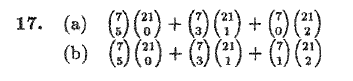
The book has solutions to the first two, which I didn't understand at all.

Please look the pic below
scymv4.png


Can someone guide me through how to approach the problem?

Thanks
 
Physics news on Phys.org
jwxie said:
Hi.

Let A = 1,2,3,4,5,6,7
How many symmetric relations on A contain exactly (a) four ordered pairs, (b) 5 , (c) seven and (d) eight

The book has solutions to the first two, which I didn't understand at all.

Please look the pic below
scymv4.png


Can someone guide me through how to approach the problem?

Thanks
You can imagine any relation a a table with 7 rows and 7 columns, where you indicate in each position whether the corresponding elements belong to the relation. (This is basically the same as working with the graph of this relation.)

A relation is symmetric if and only if this graph/table is symmetric with respect to the main diagonal. Hence, a symmetric relation is uniquely determined by the pairs on and above the main diagonal.
You have 7 positions on diagonal and 21=6+5+4+3+2+1 positions above the diagonal.
If you put a elements above the diagonal, then there are also a elements bellow it, by the symmetry. So, by putting a elements above the diagonal and b elements on the diagonal, you obtain a relation consisting of 2a+b pairs.

Now, if you want to have 4 elements you have these possibilities:
all 4 elements are on the diagonal \binom{7}{4};
2 elements on the diagonal and 1 above it \binom72\binom{21}1;
no element on the diagonal and 2 above it \binom{21}2.

For 5 elements you have the following possibilieites:
All 5 elements on the diagonal \binom75;
3 elements on the diagonal and 1 above it \binom73+\binom{21}1;
1 element on the diagonal and 2 above it \binom71+\binom{21}2.
 
The standard _A " operator" maps a Null Hypothesis Ho into a decision set { Do not reject:=1 and reject :=0}. In this sense ( HA)_A , makes no sense. Since H0, HA aren't exhaustive, can we find an alternative operator, _A' , so that ( H_A)_A' makes sense? Isn't Pearson Neyman related to this? Hope I'm making sense. Edit: I was motivated by a superficial similarity of the idea with double transposition of matrices M, with ## (M^{T})^{T}=M##, and just wanted to see if it made sense to talk...

Similar threads

  • · Replies 35 ·
2
Replies
35
Views
5K
Replies
3
Views
3K
  • · Replies 14 ·
Replies
14
Views
5K
  • · Replies 3 ·
Replies
3
Views
3K
  • · Replies 8 ·
Replies
8
Views
14K
  • · Replies 4 ·
Replies
4
Views
4K
  • · Replies 13 ·
Replies
13
Views
2K
  • · Replies 1 ·
Replies
1
Views
1K
  • · Replies 17 ·
Replies
17
Views
2K
  • · Replies 1 ·
Replies
1
Views
1K