How to calculate the applied radial load on a bearing?

Click For Summary
SUMMARY

The discussion focuses on calculating the applied radial load on a deep groove ball bearing used in a Variable Pitch Propeller design. The user successfully calculates the axial load due to thrust but seeks guidance on determining the radial load, which is influenced by forces perpendicular to the shaft. Key considerations include the weight of the shaft and propeller, as well as potential worst-case scenarios such as blade failure and vibrations from out-of-balance rotating parts. The conversation emphasizes the importance of accounting for various load cases to ensure bearing life and performance.

PREREQUISITES
  • Understanding of bearing life calculations
  • Knowledge of axial and radial loads in mechanical systems
  • Familiarity with Variable Pitch Propeller design
  • Basic principles of static and dynamic loading
NEXT STEPS
  • Research methods for calculating equivalent dynamic load on bearings
  • Explore worst-case loading scenarios for propeller systems
  • Learn about the effects of vibrations on bearing performance
  • Investigate the impact of blade failure on radial loads
USEFUL FOR

Mechanical engineers, propeller design specialists, and anyone involved in the design and analysis of bearing systems in rotating machinery.

Dency Dela Cruz
Messages
2
Reaction score
0
Hi,

I am doing design calculations for a Variable Pitch Propeller and I have to calculate bearing life. A deep groove ball bearing is used for a mainshaft (driveshaft). And the mainshaft is connected to the propeller hub.
I know the basic formula for calculating the bearing life but I am having trouble in regards with determining the equivalent dynamic load needed for the calculation. This equivalent dynamic load can be calculated by knowing the applied axial load on the bearing (due to thrust) and an applied radial loading.

I am able to calculate the axial loading due to thrust but not sure on how to go about determing the radial load on the bearing nor what is the factor the causes this load. Can anyone help me on how to go about this?

Below is an illustration of the arrangement.
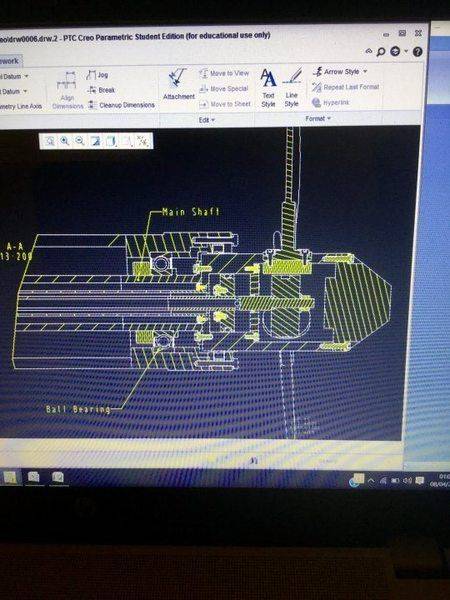
image.jpeg


Thank you
 
Engineering news on Phys.org
Can you consider the shaft as a lever and the bearing as either a fulcrum or the fixed end of the lever? Then calculate the worst case loading for various combinations of weight and end points of the lever. Remember to include vibrations from out-of-balance rotating parts (a bird strike, etc).
 
Many load cases possible . Most relevant ones usually are g and blade off . Sometimes gyro .
 
Nidum said:
Many load cases possible . Most relevant ones usually are g and blade off . Sometimes gyro .
Tom.G said:
Can you consider the shaft as a lever and the bearing as either a fulcrum or the fixed end of the lever? Then calculate the worst case loading for various combinations of weight and end points of the lever. Remember to include vibrations from out-of-balance rotating parts (a bird strike, etc).

Thanks for the reply! I did look around a bit more and found that the radial load on the bearing would be due to forces perpendicular to the shaft. So would it be reasonable if I just used the weight of the shaft + the weight of the propeller?
 
Dency Dela Cruz said:
Thanks for the reply! I did look around a bit more and found that the radial load on the bearing would be due to forces perpendicular to the shaft. So would it be reasonable if I just used the weight of the shaft + the weight of the propeller?
Well what's the specs? Does it's need to survive a worst case scenario? What are the forces in this case? Ie blade failure/ out of balance at max rpm.
 
When/if the prop hits something there will be a large radial force on the bearing. Do you care if it disintegrates then?

I've destroyed the ball bearings in an 80mm computer fan by getting my finger in the blades while it's running. Wasn't comfortable but it didn't damage my finger or the blades at all; not so the bearings (R.I.P).
 

Similar threads

Replies
4
Views
2K
  • · Replies 9 ·
Replies
9
Views
1K
  • · Replies 3 ·
Replies
3
Views
3K
  • · Replies 4 ·
Replies
4
Views
3K
  • · Replies 2 ·
Replies
2
Views
1K
  • · Replies 6 ·
Replies
6
Views
3K
  • · Replies 3 ·
Replies
3
Views
1K
Replies
5
Views
3K
  • · Replies 2 ·
Replies
2
Views
1K
  • · Replies 1 ·
Replies
1
Views
2K