How to Calculate the Distance Between Mars and Earth?

  • Context: Undergrad 
  • Thread starter Thread starter MMS
  • Start date Start date
  • Tags Tags
    Earth Mars
Click For Summary

Discussion Overview

The discussion revolves around calculating the distance between Mars and Earth as a function of time, focusing on the geometry and mathematical functions involved in this calculation. Participants explore the complexities of orbital mechanics, including the elliptical nature of the orbits and the implications for distance calculations.

Discussion Character

  • Exploratory
  • Technical explanation
  • Mathematical reasoning
  • Debate/contested

Main Points Raised

  • One participant seeks to find explicit functions for the distance R and angle Phi as a function of time, indicating a desire to understand the geometry involved.
  • Another participant notes the complexity of orbital mechanics, emphasizing that both Mars and Earth's orbits are elliptical and that their speeds differ.
  • A question is raised about the meaning of Phi, with suggestions to resolve polar coordinates into Cartesian coordinates to determine distance.
  • There is a discussion about the tangential nature of a line drawn from Mars to Earth relative to Earth's orbit, with clarification that this is not generally applicable.
  • One participant expresses uncertainty about orbital mechanics but is interested in the trajectory programming aspect.
  • A later reply proposes using the law of cosines to derive R(t) and arctan(y/x) for Phi, suggesting a potential resolution to the initial inquiry.
  • Another participant confirms the correctness of the derived functions, indicating some level of agreement on the mathematical approach taken.

Areas of Agreement / Disagreement

While there is some agreement on the mathematical approach to finding R(t) and Phi(t), the discussion contains multiple competing views regarding the complexities of orbital mechanics and the interpretation of the angle Phi. The overall discussion remains unresolved in terms of a definitive method for calculating the distance as a function of time.

Contextual Notes

Participants express limitations in their understanding of orbital mechanics, and there are unresolved questions about the general case of the angle Phi and its implications for distance calculations.

MMS
Messages
146
Reaction score
4
Hi guys,

There are many calculators and applications out there that can calculate you the distance between Earth and Mars at every time, but I'm trying to find the actual function that gives me so and draw the path of it.

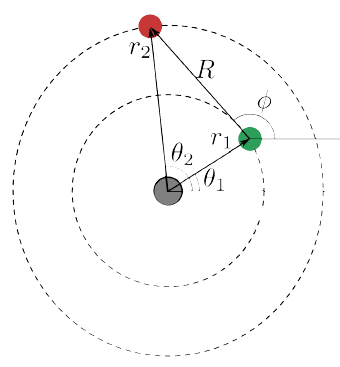
My objective is finding the distance R (and Phi of t), as shown below, as a function of time.
I'm trying to sort out some geometry here but I keep getting functions that are implicit (with R and Phi).

Any ideas how to find R and Phi and as a function of time each explicitly?
Untitled.png
 
Astronomy news on Phys.org
I don't do orbital mechanics myself, but I know that it's a lot more complex than you seem to think. To start with, both orbits are elliptical, not circular, and of course their speeds are different.
Here's a starting point: http://en.wikipedia.org/wiki/Orbital_mechanics
 
What is phi supposed to represent?

You can resolve the polar coordinates into cartesian coordinates, and then easily determine the distance.

Chet
 
Danger said:
I don't do orbital mechanics myself, but I know that it's a lot more complex than you seem to think. To start with, both orbits are elliptical, not circular, and of course their speeds are different.
Here's a starting point: http://en.wikipedia.org/wiki/Orbital_mechanics

Approximately speaking, they're circular. I can tell you both their time periods as well (Kepler's 3rd law).

Chestermiller said:
What is phi supposed to represent?

You can resolve the polar coordinates into cartesian coordinates, and then easily determine the distance.

Chet

It's simply the angle that is defined in the image.
 
MMS said:
By the way, the path that I'm trying to draw (in some program of course) is the following:
Okay, sorry. I thought that you meant something that you could use to programme a spacecraft trajectory.
 
MMS said:
It's simply the angle that is defined in the image.
You have a line drawn from Mars to Earth that is also tangent to Earth's orbit. I hope you realize that you can't generally do this.

Chet
 
Chestermiller said:
You have a line drawn from Mars to Earth that is also tangent to Earth's orbit. I hope you realize that you can't generally do this.

Chet

In that specific time it is shown to be tangent (as if someone snapped a picture at that time). Of course, it isn't the general case which I'm looking for.
 
Danger said:
Okay, sorry. I thought that you meant something that you could use to programme a spacecraft trajectory.
I'm still far from orbital mechanics so no need to worry about that now. :D
 
  • #10
MMS said:
In that specific time it is shown to be tangent (as if someone snapped a picture at that time). Of course, it isn't the general case which I'm looking for.
So, again, what does phi look like when it's not tangent, and why do you want to know phi?
 
  • #11
Chestermiller said:
So, again, what does phi look like when it's not tangent, and why do you want to know phi?

This could be phi at a different time:

Untitled.png


Knowing phi and R as a function of time helps me plot its path as shown below.
image024.gif
 
  • #12
I believe I have reached the answers. I'd be happy if someone could give it a look:

My final answer for R(t) using the law of cosine is:
image.png


And phi(t) using arctan(y/x) for R:
Untitled.png
 
  • #13
MMS said:
I believe I have reached the answers. I'd be happy if someone could give it a look:

My final answer for R(t) using the law of cosine is:
image.png


And phi(t) using arctan(y/x) for R:
Untitled.png
Yes. That looks correct.

Chet
 

Similar threads

  • · Replies 10 ·
Replies
10
Views
2K
  • · Replies 10 ·
Replies
10
Views
4K
  • · Replies 1 ·
Replies
1
Views
3K
Replies
2
Views
2K
  • · Replies 16 ·
Replies
16
Views
12K
  • · Replies 10 ·
Replies
10
Views
4K
  • · Replies 1 ·
Replies
1
Views
3K
  • · Replies 10 ·
Replies
10
Views
5K
  • · Replies 10 ·
Replies
10
Views
4K
  • · Replies 3 ·
Replies
3
Views
2K