Discussion Overview
The discussion revolves around calculating the kinetic energy of an object propelled by a magnetic field, specifically focusing on two opposing Neodymium magnets. Participants explore various methods and assumptions related to the work-energy theorem, the behavior of magnetic forces over distance, and the efficiency of energy transfer during the motion of the magnets.
Discussion Character
- Exploratory
- Technical explanation
- Debate/contested
- Mathematical reasoning
Main Points Raised
- One participant questions the assumption that the magnetic force remains constant over the distance, noting that the force rapidly decreases as the magnets move apart.
- Another participant suggests using the work-energy theorem to estimate kinetic energy, proposing that the force should be treated as a function of position to accurately calculate work done.
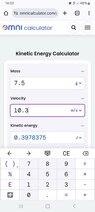
- Some participants provide calculations for kinetic energy based on different assumptions about the force, with varying results and methods, including integration of force over distance.
- A participant discusses breaking down the movement into smaller increments to account for changing force and calculates the total energy based on field strength at each increment.
- There are clarifications about the conversion of force units and the implications of using average force over distance.
- Concerns are raised about how diminishing magnetic field strength affects energy accumulation and whether reduced force acts as a holding force that takes away energy.
Areas of Agreement / Disagreement
Participants express differing views on the behavior of magnetic forces over distance and the appropriate methods for calculating kinetic energy. There is no consensus on the correct approach or final answer, with multiple competing models and calculations presented.
Contextual Notes
Participants highlight limitations in their calculations, such as the need for a precise function for force as a function of position and the assumptions made regarding the behavior of magnetic fields. The discussion also reflects uncertainty about the practical implications of theoretical calculations.
Who May Find This Useful
This discussion may be of interest to individuals exploring the physics of magnetism, energy transfer in magnetic systems, and those engaged in experimental physics or engineering applications involving magnets.