How to Calculate the Shortest Pulse Duration of a Mode-Locked Ti-Sapphire Laser?

  • Thread starter Thread starter ATY
  • Start date Start date
  • Tags Tags
    Laser Pulse
Click For Summary

Homework Help Overview

The discussion revolves around calculating the shortest pulse duration of a mode-locked Ti-Sapphire laser, with a focus on the output spectrum and its Gaussian shape. Participants are exploring the relationship between the spectrum width and pulse duration using Fourier transformation.

Discussion Character

  • Exploratory, Conceptual clarification, Mathematical reasoning, Assumption checking

Approaches and Questions Raised

  • Participants discuss using the time bandwidth product to relate spectrum width to pulse duration. Questions arise about the parameters provided, specifically the wavelength range of the laser and how to apply Fourier transformation to find the shortest pulse duration.

Discussion Status

Some participants have offered insights into the time bandwidth product and the relationship between time and frequency domain widths. However, there is ongoing uncertainty regarding the specific parameters needed for calculations and how to properly apply Fourier transformation in this context.

Contextual Notes

Participants note that the task does not provide detailed information about the laser, leading to questions about the definition of spectrum width and whether it refers to full width at half maximum (FWHM). There is also mention of a specific pulse duration capability of the laser, but it is unclear how this relates to the task requirements.

ATY
Messages
30
Reaction score
1
Hey guys,
I really need your help.
I got the following task:
"Sketch the output spectrum of a mode-locked Ti-Sapphire laser (assuming eg. gaussian shape) and calculate the shortest possible pulse duration by Fourier transformation."
So the spectrum is gauss shaped but I have no clue how to get the shortest possible pulse duration.
I thought about starting with something like

c363b850c5.jpg
and get something that I can use with the time bandwidth product
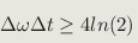
5be9dd0593.jpg
.
But the first equation does not contain the mode-locking thing and I have no idea how to calculate the stuff.

I am an absolute beginner without any knowledge about lasers (and bad english).
I hope that somebody understands my question and is able to help me.
Have a nice day
ATY
 
Physics news on Phys.org
Yes, you can use the time bandwidth product analysis by fixing the spectrum width ##\Delta \omega##. This way you can express the shortest duration ##\Delta t_{min}## in terms of ##\Delta \omega##. Just that, which parameters are you given?
 
The only parameter we got are the wavelength of the laser. From 690nm to 1080nm. this would give me the spectrum width, but how do I get the shortest duration if I have to use the Fourier transformation ?
 
ATY said:
From 690nm to 1080nm
So, is this the full width at half maximum (FWHM) in terms of wavelength?
 
Not sure. The text says:
"With properly chosen optics, the TI:Sa laser is in general capable of delivering pulsesin the wavelength reange from 690nm to 1080nm and pulse durations down to 6fs"
The task itself does not give any information about he laser and I just took this from the text a few sites before the task.
 
In general, there are a number of ways to characterize the width of a localized function, as for the case of the spectrum of a laser it's usually defined as the FWHM of the power spectrum. Anyway, whatever measure of the widths used, the widths in time and frequency domain always satisfy the relation ##\Delta \omega \Delta t \geq K## where ##K## is a constant that depends on the definition of the widths and the particular shapes of the functions in time and frequency domains. For a Gaussian functions in frequency (and also in time) along with FWHM to describe the widths, ##K=0.441##. From this, it should be straightforward to determine ##\Delta t_{min}##.
 
you are right, but the task requires to get the shortest possible amount by Fourier transformation
ATY said:
calculate the shortest possible pulse duration by Fourier transformation
 
ATY said:
but the task requires to get the shortest possible amount by Fourier transformation
It asks for ##\Delta t_{min}##, which is the shortest pulse duration.
 

Similar threads

Replies
1
Views
2K
Replies
22
Views
3K
Replies
3
Views
12K
  • · Replies 1 ·
Replies
1
Views
1K
  • · Replies 1 ·
Replies
1
Views
2K
  • · Replies 4 ·
Replies
4
Views
3K
  • · Replies 3 ·
Replies
3
Views
2K
  • · Replies 12 ·
Replies
12
Views
10K
  • · Replies 1 ·
Replies
1
Views
3K
  • · Replies 10 ·
Replies
10
Views
3K