High School How to calculate time with delta-v and velocity?

Click For Summary
SUMMARY

The discussion focuses on calculating time using delta-v (dv) and velocity in the context of physics, specifically through the equation t = d/v. It highlights the importance of using correct units, emphasizing that velocity must be in meters per second (m/s) and distance in meters. The correct approach involves using the relationship between acceleration and time, expressed as dv/dt = a, leading to the integration of the equations to derive t_needed = v_needed/a. The conversation underscores the necessity of constant acceleration for accurate calculations.

PREREQUISITES
  • Understanding of basic physics concepts, specifically acceleration and velocity.
  • Familiarity with dimensional analysis in physics.
  • Knowledge of calculus, particularly integration techniques.
  • Ability to manipulate and convert units of measurement.
NEXT STEPS
  • Study the principles of constant acceleration in physics.
  • Learn about dimensional analysis and its applications in physics calculations.
  • Explore integration techniques in calculus relevant to physics problems.
  • Investigate the implications of unit conversions in scientific equations.
USEFUL FOR

Students in physics, engineers working on motion-related calculations, and anyone interested in understanding the relationship between velocity, acceleration, and time in practical applications.

alberto91
Messages
15
Reaction score
19
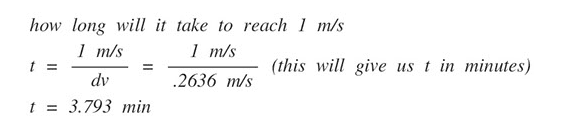
Is this correct?

Sin título.png


Why the time is minutes instead of seconds?

Thanks!
 
  • Like
Likes Delta2
Mathematics news on Phys.org
By dimensional analysis your t has no units.
 
WWGD said:
By dimensional analysis your t has no units.

And how can I calculate that equation?
 
What I mean is you're dividing two expressions with m/s as units, which cancel out. This tells you you're doing something wrong somewhere. I guess you want to use t=d/v? Then d is given in meters ( or another unit of distance) . In your case you used 1 m/s , which is not a measure of distance.
 
WWGD said:
What I mean is you're dividing two expressions with m/s as units, which cancel out. This tells you you're doing something wrong somewhere. I guess you want to use t=d/v? Then d is given in meters ( or another unit of distance) . In your case you used 1 m/s , which is not a measure of distance.

Thanks for your answer.

I want to use delta-vee (dv)
 
To find the time you need a relationship between velocity and time such as the definition of acceleration:

##\frac{dv}{dt}=a##

Then separate and integrate:

##dv=adt \rightarrow \int_{0}^{v_{needed}} dv = \int_{0}^{t_{needed}}a dt##

This gives

##v_{needed} = at_{needed}##

So to find the time needed to get to the needed velocity, simply divide.

##t_{needed} = v_{needed}/a##

Note that this assumes constant acceleration from zero. So it seems the solution you showed has the wrong units for acceleration.
 
Last edited:
There is context missing. Do you have a constant acceleration? If yes, what is its value? Maybe 0.2636 m/(s*min)?
 

Similar threads

  • · Replies 41 ·
2
Replies
41
Views
2K
  • · Replies 2 ·
Replies
2
Views
2K
  • · Replies 23 ·
Replies
23
Views
3K
  • · Replies 2 ·
Replies
2
Views
2K
  • · Replies 7 ·
Replies
7
Views
3K
  • · Replies 2 ·
Replies
2
Views
1K
  • · Replies 2 ·
Replies
2
Views
2K
  • · Replies 2 ·
Replies
2
Views
3K
  • · Replies 10 ·
Replies
10
Views
3K
  • · Replies 20 ·
Replies
20
Views
2K