How to determine the force on the linkage

Click For Summary
SUMMARY

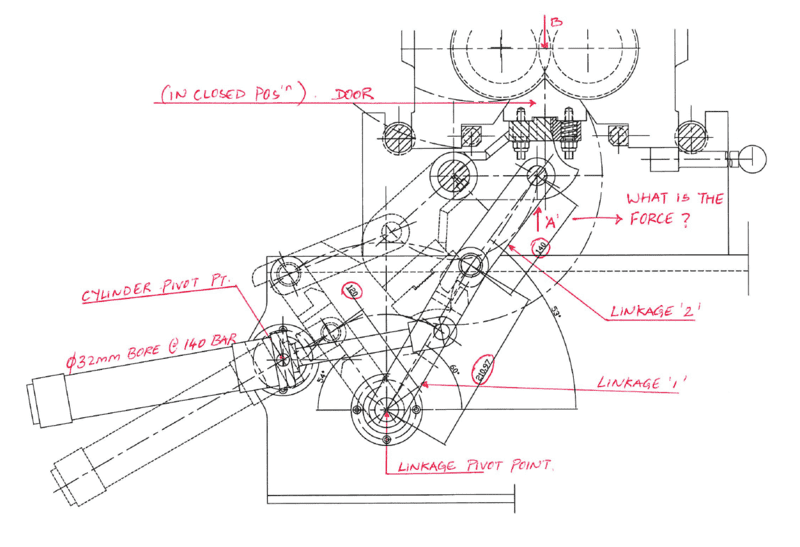
The discussion focuses on calculating the force at point 'A' in a door opening and closing mechanism utilizing a hydraulic cylinder with a 32mm diameter bore operating at 140 bar. The cylinder exerts a force of 11.26 kN on the first link, which is crucial for determining the force at point 'A' when the door is closed. Participants suggest using simple mechanics, particularly moments, and the method of virtual work to analyze the forces and torques involved in the linkage system. The challenge lies in the ill-conditioned nature of the problem when the linkages align, leading to indeterminate forces.

PREREQUISITES
  • Understanding of hydraulic systems, specifically hydraulic cylinders and their force output.
  • Knowledge of mechanics, particularly moments and torque calculations.
  • Familiarity with linkage systems and their configurations in mechanical design.
  • Experience with the method of virtual work for solving mechanical problems.
NEXT STEPS
  • Study the principles of hydraulic force calculations, focusing on hydraulic cylinder specifications.
  • Learn about torque calculations in mechanical linkages and how to apply them effectively.
  • Research the method of virtual work and its applications in mechanical systems analysis.
  • Explore the design and function of automotive door latching mechanisms for practical insights.
USEFUL FOR

Mechanical engineers, designers of hydraulic systems, and anyone involved in the analysis of linkage mechanisms will benefit from this discussion.

sach2606
Messages
2
Reaction score
0
hi
Wondering if someone could help.
I need to know how to work out the the force at point 'A' ( see sketch attached).
Its a door opening and closing mechanism and it consists of a hydraulic cylinder 32mm dia bore operating at 140 bar. The door is opened and closed via couple of linkages as the cylinder opens and retracts.

I presume there will be some force losses due to the linkages at point 'A'. I am struggling to work out what will be the force at 'A' when the door is in closed position to ensure we don't put enough force at point 'B' for it to open.

Your help will be much appreciated.
upload_2018-10-17_9-58-49.png
 

Attachments

Engineering news on Phys.org
I can't get very far with this, because I can't work out what the pivot point is for the door, nor where the fixed points are for attachment to the frame.
I think you should sketch a simple diagram of the linkage in the position you want, showing the door and frame.
Label any forces you know, then use simple mechanics, mainly moments I'd think here, to work through the mechanism.

To me, you seem to have an ill-conditioned problem. Linkage 1 and 2 are nearly straight in line when the door is closed.
When they are exactly in line, the end force will be indeterminate, unrelated to any turning force.
As they approach that point, the force can rise indefinitely for a tiny change in angle. The door would be locked by this mechanism if it passed straight.

For your open position, you are slightly further away from having two straight linkages, but not far.
 
hi
Thank you for the response, much appreciated.
I have a sketch as attached showing the fixed positions, I hope it makes sense.
Basically the cylinder exerts a force of 11.26kn on the first link which in turns holds the door in closed position via the second link.

All I want to know is how to work out the correct force at point 'A'?

upload_2018-10-18_13-13-9.png
 

Attachments

Try working out some torques and forces, starting with the one you know.
 
The latching mechanism appears to be the insertion of the inverted V-shaped part between two rollers; is this correct? What is the application of this mechanism? It looks more like an automotive door latch than something I would expect to find in a lab.

I work problems of this sort all the time, and I find the method of virtual work to be the best approach most of the time. Have you tried that?
 

Similar threads

  • · Replies 12 ·
Replies
12
Views
2K
  • · Replies 8 ·
Replies
8
Views
2K
  • · Replies 9 ·
Replies
9
Views
2K
Replies
13
Views
3K
  • · Replies 10 ·
Replies
10
Views
7K
Replies
4
Views
2K
  • · Replies 2 ·
Replies
2
Views
4K
  • · Replies 23 ·
Replies
23
Views
10K
Replies
2
Views
2K
  • · Replies 1 ·
Replies
1
Views
6K