How to determine the force on the linkage

Click For Summary

Discussion Overview

The discussion revolves around determining the force at point 'A' in a door opening and closing mechanism that utilizes a hydraulic cylinder and linkages. Participants explore the mechanics involved, including forces and torques, while addressing the challenges posed by the linkage configuration.

Discussion Character

  • Technical explanation
  • Debate/contested
  • Mathematical reasoning

Main Points Raised

  • One participant seeks assistance in calculating the force at point 'A' when the door is closed, considering potential force losses due to the linkages.
  • Another participant highlights the importance of identifying the pivot point and fixed attachment points for the door, suggesting the use of a diagram to clarify the mechanics involved.
  • Concerns are raised about the problem being ill-conditioned due to the linkages being nearly straight in line when the door is closed, which could lead to indeterminate forces.
  • A participant mentions that the cylinder exerts a known force of 11.26 kN on the first link, which affects the force at point 'A'.
  • One participant suggests using torques and forces as a starting point for calculations.
  • Another participant questions the design of the latching mechanism and suggests that the method of virtual work may be an effective approach for solving such problems.

Areas of Agreement / Disagreement

Participants express differing views on how to approach the problem, with no consensus on the best method to calculate the force at point 'A' or the implications of the linkage configuration.

Contextual Notes

Participants note the complexity of the linkage system and the potential for indeterminate forces when the linkages are nearly aligned. There is also uncertainty regarding the fixed points and pivot locations, which may affect calculations.

sach2606
Messages
2
Reaction score
0
hi
Wondering if someone could help.
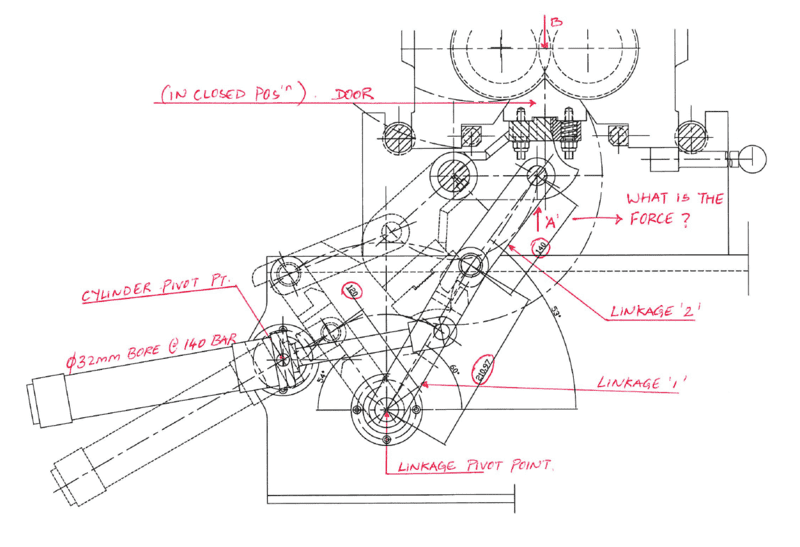
I need to know how to work out the the force at point 'A' ( see sketch attached).
Its a door opening and closing mechanism and it consists of a hydraulic cylinder 32mm dia bore operating at 140 bar. The door is opened and closed via couple of linkages as the cylinder opens and retracts.

I presume there will be some force losses due to the linkages at point 'A'. I am struggling to work out what will be the force at 'A' when the door is in closed position to ensure we don't put enough force at point 'B' for it to open.

Your help will be much appreciated.
upload_2018-10-17_9-58-49.png
 

Attachments

Engineering news on Phys.org
I can't get very far with this, because I can't work out what the pivot point is for the door, nor where the fixed points are for attachment to the frame.
I think you should sketch a simple diagram of the linkage in the position you want, showing the door and frame.
Label any forces you know, then use simple mechanics, mainly moments I'd think here, to work through the mechanism.

To me, you seem to have an ill-conditioned problem. Linkage 1 and 2 are nearly straight in line when the door is closed.
When they are exactly in line, the end force will be indeterminate, unrelated to any turning force.
As they approach that point, the force can rise indefinitely for a tiny change in angle. The door would be locked by this mechanism if it passed straight.

For your open position, you are slightly further away from having two straight linkages, but not far.
 
hi
Thank you for the response, much appreciated.
I have a sketch as attached showing the fixed positions, I hope it makes sense.
Basically the cylinder exerts a force of 11.26kn on the first link which in turns holds the door in closed position via the second link.

All I want to know is how to work out the correct force at point 'A'?

upload_2018-10-18_13-13-9.png
 

Attachments

Try working out some torques and forces, starting with the one you know.
 
The latching mechanism appears to be the insertion of the inverted V-shaped part between two rollers; is this correct? What is the application of this mechanism? It looks more like an automotive door latch than something I would expect to find in a lab.

I work problems of this sort all the time, and I find the method of virtual work to be the best approach most of the time. Have you tried that?
 

Similar threads

  • · Replies 12 ·
Replies
12
Views
2K
  • · Replies 8 ·
Replies
8
Views
3K
  • · Replies 9 ·
Replies
9
Views
2K
Replies
13
Views
3K
  • · Replies 10 ·
Replies
10
Views
7K
Replies
4
Views
2K
  • · Replies 2 ·
Replies
2
Views
4K
  • · Replies 23 ·
Replies
23
Views
10K
Replies
2
Views
2K
  • · Replies 1 ·
Replies
1
Views
6K