How to find cp and cv from example problem 11.1

3 replies · 7K views · last reply
williamcarter
Messages
153
Reaction score
4
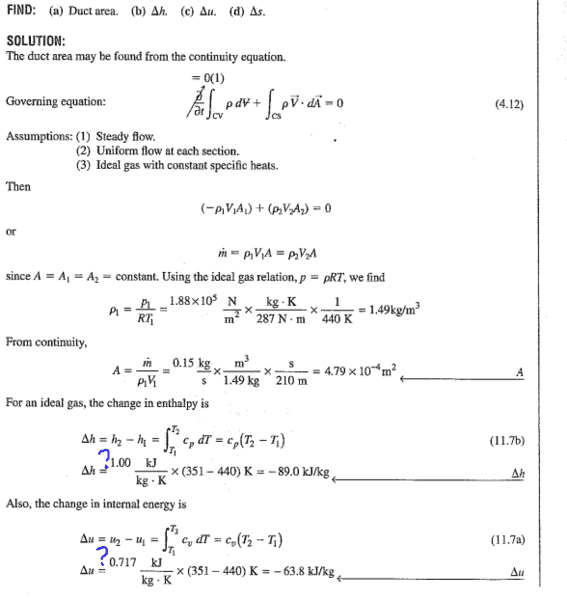
Hello, I tried attempting the following example problem 11.1(please see below), however I don't quite get from where they got cp=1.00 and cv=0.717?
I know that Q=m*cp*delta T=> cp=Q/(m*delta T)
Q=n*cv*delta T=>cv=Q/(n*deltaT)

Problem statement
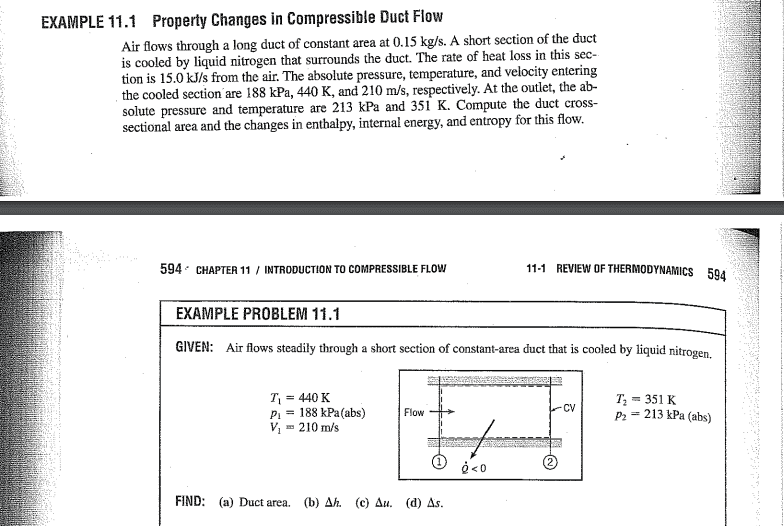
Textbook page showing Example Problem 11.1: air flows steadily through a constant-area duct cooled by liquid nitrogen, with inlet T1 = 440 K, p1 = 188 kPa (abs), V1 = 210 m/s and outlet T2 = 351 K, p2 = 213 kPa (abs), and a schematic of the duct with heat transfer Q-dot < 0.
Their solution:
Worked solution for finding duct area and changes in enthalpy and internal energy of an ideal gas, using continuity and cp = 1.00 kJ/kg·K, cv = 0.717 kJ/kg·K with temperatures 351 K and 440 K.


How did they manage to get for cp=1.00 and cv=0.717?

Thank you
 
Chestermiller said:
(3.5)(8.314)/29=1.00
Thank you , but how did you get these numbers from? They are not given in the statement of the problem.
What about cv?
 
In terms of the ideal gas constant R and the number of degrees of freedom f, what is the equation for the molar heat capacity at constant volume of an ideal gas? In terms of the ideal gas constant R, what is the relationship between the molar heat capacity at constant pressure and the molar heat capacity at constant volume of an ideal gas?
 
Last edited: