How to Find Initial Conditions for a Fifth Order ODE in Visco-Elastic Models?

Click For Summary

Discussion Overview

The discussion revolves around finding initial conditions for a fifth order ordinary differential equation (ODE) that models the behavior of a visco-elastic material consisting of multiple springs and dashpots. The focus is on the challenges faced in determining these initial conditions, particularly in the context of a constant stress applied to the system.

Discussion Character

  • Technical explanation
  • Debate/contested

Main Points Raised

  • One participant expresses difficulty in finding the initial conditions for a fifth order ODE related to visco-elastic materials, having identified only one initial condition so far.
  • Another participant clarifies the distinction between solving a differential equation and solving an initial value problem, emphasizing that without initial conditions, a unique solution cannot be determined.
  • There is a suggestion that typical problems involving mass, spring, and damping systems usually result in second order differential equations, raising questions about the formulation of the fifth order ODE.
  • Confusion arises regarding the symbols used in the equations, with requests for clarification on their meanings and roles in the context of the problem.
  • A participant questions the existence of a fifth order ODE, proposing that the system might instead consist of five first order ODEs, and seeks further clarification on this point.
  • Reference to external documentation is made, which discusses similar modeling problems, indicating that the participant is looking for guidance based on established examples.

Areas of Agreement / Disagreement

Participants do not reach consensus on the formulation of the ODE or the nature of the initial conditions required. There are competing views on whether the problem can be framed as a fifth order ODE or if it should be approached as multiple first order ODEs.

Contextual Notes

Participants express uncertainty regarding the definitions and roles of various symbols in the equations, which may impact the understanding of the initial conditions needed. The discussion also highlights a lack of clarity on the mathematical formulation of the problem.

Joa
Messages
3
Reaction score
0
TL;DR
I am struggling to find the initial conditions to a 5th order ODE describing visco-elastic material behavior
Hello,

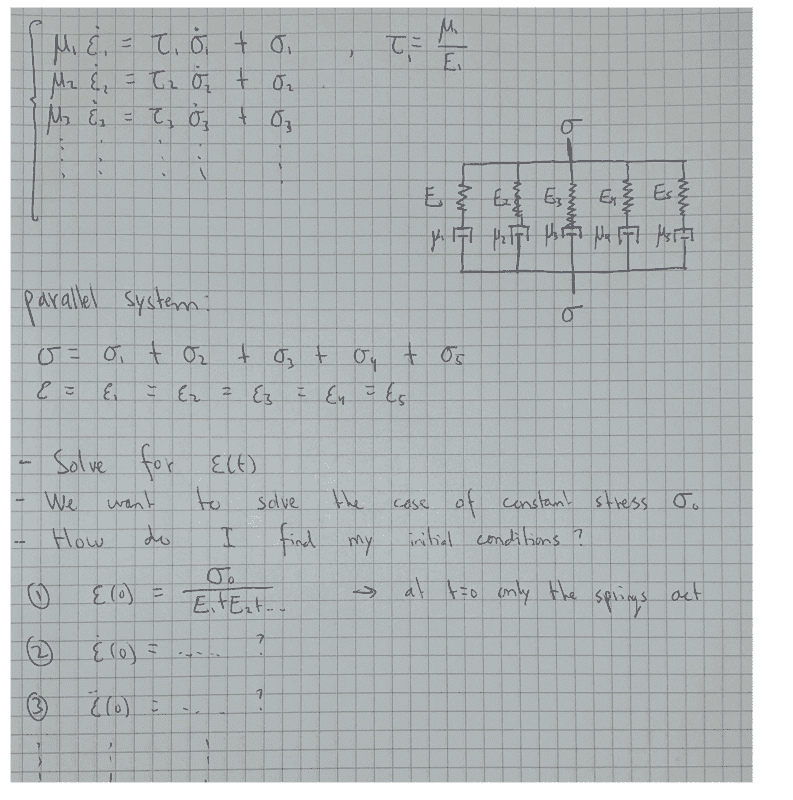
I am trying to solve a differential equation corresponding to a visco-elastic material model consisting of 5 units of springs and dashpots connected in parallel as can be seen in the image below. I am able to come-up with a single fifth order ODE, however I am struggling to find the initial conditions for t=0. The differential equation is solved for epsilon(t) and is subject to a constant stress sigma_0. I am able to come-up with the first initial condition as can be seen in the image but I don't know how to find the remaining 4 conditions. Please help!

Joa
problem.png
 
Physics news on Phys.org
Joa said:
Summary: I am struggling to find the initial conditions to a 5th order ODE describing visco-elastic material behavior

Hello,

I am trying to solve a differential equation corresponding to a visco-elastic material model consisting of 5 units of springs and dashpots connected in parallel as can be seen in the image below. I am able to come-up with a single fifth order ODE, however I am struggling to find the initial conditions for t=0. The differential equation is solved for epsilon(t) and is subject to a constant stress sigma_0. I am able to come-up with the first initial condition as can be seen in the image but I don't know how to find the remaining 4 conditions. Please help!

JoaView attachment 253342
I don't understand your question. There is a difference between solving a differential equation, and solving an initial value problem (which involves a differential equation and one or more initial conditions).

A simple example of a differential equation is y' - y = 0, for which the general solution is ##y = Ae^t##. It is not possible to find the constant A nor is it possible to get a unique value for y(0), since no initial condition is given.

Now consider an initial value problem such as y' - y = 0, with y(0) = 2. Knowing the initial condition allows us to determine that A = 2, so the unique solution is ##y = 2e^t##.

So in short, just being able to go from a differential equation to a general solution (or family of solutions) in no way let's us determine an initial condition.
 
Mark44 said:
I don't understand your question. There is a difference between solving a differential equation, and solving an initial value problem (which involves a differential equation and one or more initial conditions).

A simple example of a differential equation is y' - y = 0, for which the general solution is ##y = Ae^t##. It is not possible to find the constant A nor is it possible to get a unique value for y(0), since no initial condition is given.

Now consider an initial value problem such as y' - y = 0, with y(0) = 2. Knowing the initial condition allows us to determine that A = 2, so the unique solution is ##y = 2e^t##.

So in short, just being able to go from a differential equation to a general solution (or family of solutions) in no way let's us determine an initial condition.

Finding the general solution to the problem is not the issue here. I am able to formulate the general solution to the problem, but then i am left with 5 unknown constants which can be solved using the initial conditions. However formulating these initial conditions is the thing I am struggling with. So far I only found one initial conditions as can be seen in the image. Does this clarify my question?
 
Joa said:
Does this clarify my question?
No. As I said in my previous post, being able to find the general solution to a differential equation doesn't enable one to find initial conditions.

Also, it's difficult for me to understand what you're doing. A typical problem involving a mass, spring, and damping dashpot is a second order differential equation. To find a unique solution you would need the initial position and initial velocity of the mass in this system.

Also, it's not clear to me what the symbols you're using represent. You have ##\epsilon_1, \dot{\epsilon_1}## etc., ##\tau_1## etc. ##\sigma_1, \dot{\sigma_1}, \mu_1##, etc. and ##E_1## etc.
Presumably the ##\mu##s are the masses attached to the springs, and possibly ##\sigma_i## is a position and ##\dot{\sigma_i}## is a velocity, but which of the symbols you're using is an acceleration?
 
Mark44 said:
No. As I said in my previous post, being able to find the general solution to a differential equation doesn't enable one to find initial conditions.

Also, it's difficult for me to understand what you're doing. A typical problem involving a mass, spring, and damping dashpot is a second order differential equation. To find a unique solution you would need the initial position and initial velocity of the mass in this system.

Also, it's not clear to me what the symbols you're using represent. You have ##\epsilon_1, \dot{\epsilon_1}## etc., ##\tau_1## etc. ##\sigma_1, \dot{\sigma_1}, \mu_1##, etc. and ##E_1## etc.
Presumably the ##\mu##s are the masses attached to the springs, and possibly ##\sigma_i## is a position and ##\dot{\sigma_i}## is a velocity, but which of the symbols you're using is an acceleration?

The following document provides some background to what I am trying to model. Specifically on page 20-22 a problem similar to mine is evaluated. There two Maxwell units in parallel are used. I am trying to use five units.
http://homepages.engineering.auckla...scoelasticity/10_Viscoelasticity_Complete.pdf
 
I don't see a fifth order ODE at all, but instead five first order ODEs -- assuming ##\sigma## is the input1 and ##\varepsilon## is to be found2. They can be added up to one first order ODE. Please enlighten me if I am wrong ? (And I think I am... :cool: )

1 I derive from
1579623241002.png


2 You found already
1579623324770.png
With your
Joa said:
1579621639015.png
(Gee, it's a drag to quote from a picture -- ##\LaTeX## is soooo much better... )

Anyway with that you have established ##{\dot\epsilon}_0 = 0## and also that ##\dot\sigma_0 = 0## -- I think.

Joa said:
Specifically on page 20-22 a problem similar to mine is evaluated
Strange: page 20 (302) is already further:10.3b Retardation and Relaxation spectra.

But 10.3.6 Generalized Models on page 300 has a picture like the one in your post #1:

1579622491023.png

with a warning that
"Piaras Kelly: Solid Mechanics Part I: An Introduction to Solid Mechanics" said:
1579622520003.png
 

Similar threads

Replies
10
Views
3K
  • · Replies 3 ·
Replies
3
Views
3K
  • · Replies 1 ·
Replies
1
Views
5K
  • · Replies 1 ·
Replies
1
Views
2K
  • · Replies 2 ·
Replies
2
Views
3K
Replies
2
Views
2K
  • · Replies 1 ·
Replies
1
Views
2K
  • · Replies 8 ·
Replies
8
Views
3K
Replies
1
Views
2K
  • · Replies 1 ·
Replies
1
Views
2K