How to find one corresponding eigenvector?

  • Thread starter Thread starter Math100
  • Start date Start date
  • Tags Tags
    Eigenvector
Join the discussion
Registration is free. Ask a follow-up in this thread, or start your own.
8 replies · 2K views
Math100
Messages
823
Reaction score
234
Homework Statement
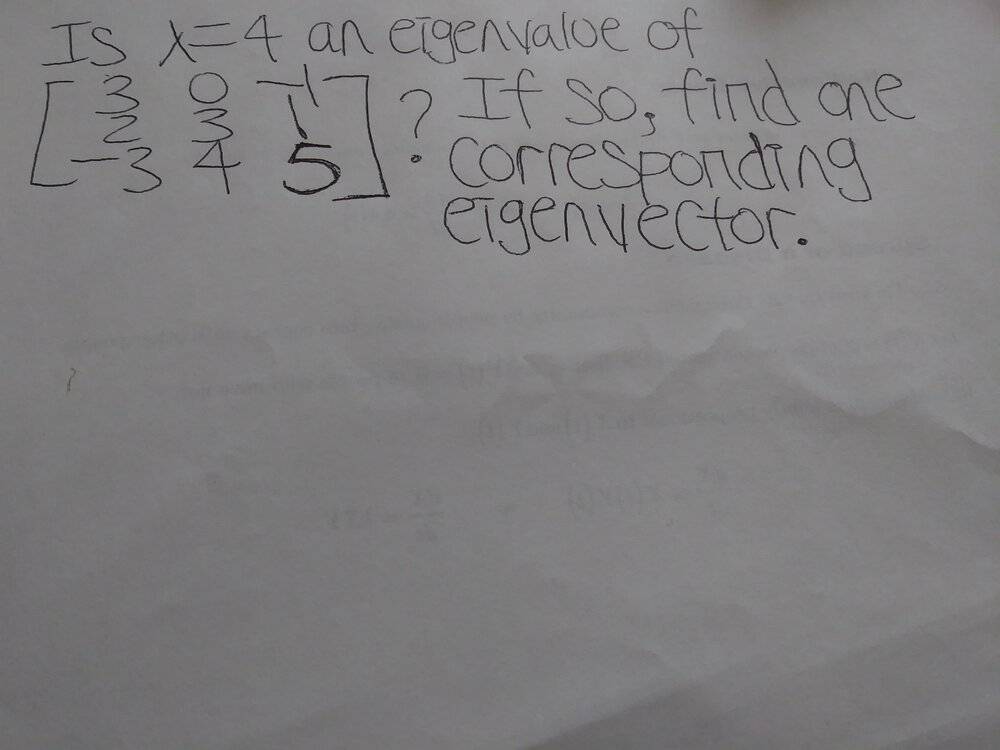
Is lambda=4 an eigenvalue of the given matrix? If so, find one corresponding eigenvector.
Relevant Equations
None.
The determinant is 0, which means that A-4I has a nullspace, and there is an eigenvector with eigenvalue 4. In the textbook, the answer says "Yes, [1, 1, -1]" for this problem. But I don't know how to find the corresponding eigenvector for this problem. Below is my work.
20200815_122334.jpg
20200815_123833.jpg
 
Physics news on Phys.org
Math100 said:
Homework Statement:: Is lambda=4 an eigenvalue of the given matrix? If so, find one corresponding eigenvector.
Relevant Equations:: None.

The determinant is 0, which means that A-4I has a nullspace, and there is an eigenvector with eigenvalue 4. In the textbook, the answer says "Yes, [1, 1, -1]" for this problem. But I don't know how to find the corresponding eigenvector for this problem. Below is my work.
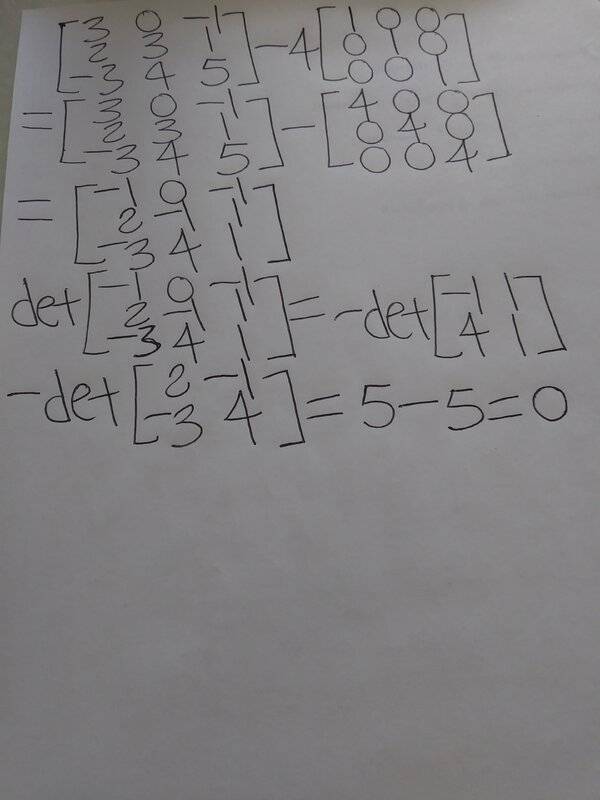
You have to find a vector ##\vec{v}\neq 0## such that ##(A-4I)\vec{v}=0##. Can you solve this equation system?
 
  • Like
Likes   Reactions: DaveE
How should I find the vector then?
 
I think an easy way to remember these equations is to memorize the concept that the eigenvectors of A are the vectors that "don't change direction" when transformed by the matrix A, they only change in length. That length change is the eigenvalue for that vector. So Aν = λν. All of the equations you need (see @fresh_42) follow from this concept with some matrix algebra.
 
But I didn't get the answer from the book. As a result, I got x=y=z=0, the book says x=1, y=1, z=-1.
20200816_100427.jpg
 
You will find, when solving for the eigenvectors, that there isn't a single (non-trivial, ν=0) solution. This is because all vectors in the same direction as an eigenvector satisfy the basic requirement that Aν=λν, since these are linear transformations ( A(kν)=kAν for any scalar k). So, we would normally arbitrarily assign a value to one component. Like x=1, for example, and then solve for the others (everyone always chooses x=1, it seems). You could express it as (1,1,-1)T, (2,2,-2)T, etc., or as (x,x,-x)T (which, of course, is x⋅(1,1,-1)T). These are all solutions.