Find Side AB: Calculate Using m & n Ratios

  • Thread starter Thread starter quee
  • Start date Start date
Click For Summary

Homework Help Overview

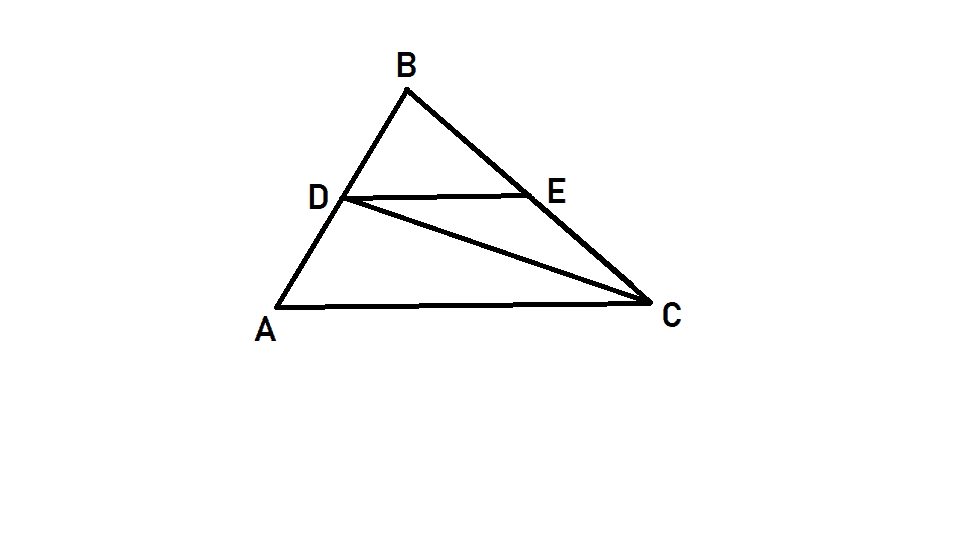
The problem involves a triangle ABC with a line drawn through point D on side AB, parallel to AC, intersecting BC at E. The ratio CD:DB is given as m:n, and the task is to find the ratio DE:AC.

Discussion Character

  • Mixed

Approaches and Questions Raised

  • Participants discuss the relationships between the segments of the triangle and the implications of the given ratios. Some explore the use of similar triangles and the intercept theorem, while others express concerns about the sufficiency of the provided information.

Discussion Status

There is an ongoing exploration of the relationships between the segments, with some participants suggesting methods involving additional points and segments. However, there is a recognition of potential gaps in the information provided, leading to uncertainty about the path forward.

Contextual Notes

Some participants question whether the problem contains enough information to reach a conclusion, particularly regarding the ratios and the relationships between the segments involved.

quee
Messages
7
Reaction score
2
Hello.
There is a problem:
"Through D on a side AB of the triangle ABC drawn a line parallel to AC intersecting BC in E. D is such that CD:DB = m:n. Find DE:AC"
1.png


So it is easy to find out that DB:AB equals to DE:AC as DE and AC are parallel. Since DB = n, there is only one need to express AB in terms of n and m. But how to do it? I tried using similar triangles, but I can't get AB through it. The trapezoid ADEC also gives no results as the second diagonal is unknown.
 
Physics news on Phys.org
I think you need also ##AE## and the intersection of both diagonals ##AE## and ##CD## in, say ##F##. This will make things more complicated as there will be more lengths involved, but I don't see another way to get hold on ##CD##. Then use the intercept theorem.
 
  • Like
Likes   Reactions: quee
fresh_42 said:
I think you need also ##AE## and the intersection of both diagonals ##AE## and ##CD## in, say ##F##.
Thank you. Actually, I considered that there may be not enough information in the problem. Now I am convinced.
 
quee said:
Thank you. Actually, I considered that there may be not enough information in the problem. Now I am convinced.
I am not sure. It depends on how the result has to look like. E.g. I got for the quotient
$$\dfrac{DE}{AC} =\dfrac{n}{m} \cdot \dfrac{CD}{AD+DB}$$
but it's not clear whether this will do or not. I don't see a second equation for ##CD##.
 
  • Like
Likes   Reactions: quee
Since ##DE## is parallel to ##AC##, you can use the similarity of triangles ##ABC## and ##ADE##. You have from the proportion that is given:
$$AD:DB = m:n \Rightarrow nAD = mDB$$
This means that ##AB = AD + DB = \left(\frac{m}{n} + 1\right) DB##. So now you have the proportion between ##AB## and ##DB## and from similarity you get the proportion between ##DE## and ##AC##.
 
  • Like
Likes   Reactions: Delta2
Antarres said:
Since ##DE## is parallel to ##AC##, you can use the similarity of triangles ##ABC## and ##ADE##. You have from the proportion that is given:
$$AD:DB = m:n \Rightarrow nAD = mDB$$
This means that ##AB = AD + DB = \left(\frac{m}{n} + 1\right) DB##. So now you have the proportion between ##AB## and ##DB## and from similarity you get the proportion between ##DE## and ##AC##.
Did you misread the given information?

Statement says: ##CD:DB = m:n##, not ##AD:DB ##.
quee said:
D is such that CD:DB = m:n. Find DE:AC"
 
@SammyS Indeed, I completely misread it. Apologies to the OP. In that case the exercise seems more complicated.
Might be that the method fresh gave would work, I so far don't see a clear way to get the proportion.
 
Antarres said:
Indeed, I completely misread it. Apologies to the OP.

It is okay. Thank you for your reply.
If only $$AD:DB= m:n,$$ it would be completely obvious that $$\frac{DE}{AC} = \frac{n}{n+m}$$
But this is, unfortunately, a much harder problem. Or it may be an actual lack of some information in the problem.
 
  • Like
Likes   Reactions: SammyS

Similar threads

  • · Replies 5 ·
Replies
5
Views
3K
  • · Replies 4 ·
Replies
4
Views
4K
Replies
2
Views
2K
  • · Replies 1 ·
Replies
1
Views
2K
  • · Replies 1 ·
Replies
1
Views
3K
  • · Replies 2 ·
Replies
2
Views
2K
  • · Replies 6 ·
Replies
6
Views
3K
  • · Replies 1 ·
Replies
1
Views
1K
Replies
14
Views
10K
  • · Replies 1 ·
Replies
1
Views
2K