k.udhay
- 167
- 13
- Homework Statement
- A known mass at a know velocity collides on a spring of known stiffness. What is the equation that governs the deceleration of the mass, so that the force on the spring could be found?
- Relevant Equations
- 1/2 m*V^2 = 1/2*k*x^2 + 1/2*m*(Vo)^2
Kinetic energy of mass before collision = Potential energy of spring at an instance + Kinetic energy of mass at the same instance
Problem Statement: A known mass at a know velocity collides on a spring of known stiffness. What is the equation that governs the deceleration of the mass, so that the force on the spring could be found?
Relevant Equations: 1/2 m*V^2 = 1/2*k*x^2 + 1/2*m*(Vo)^2
Kinetic energy of mass before collision = Potential energy of spring at an instance + Kinetic energy of mass at the same instance
I am creating a simple mathematical model to understand the impact of a moving object on a sprung system:
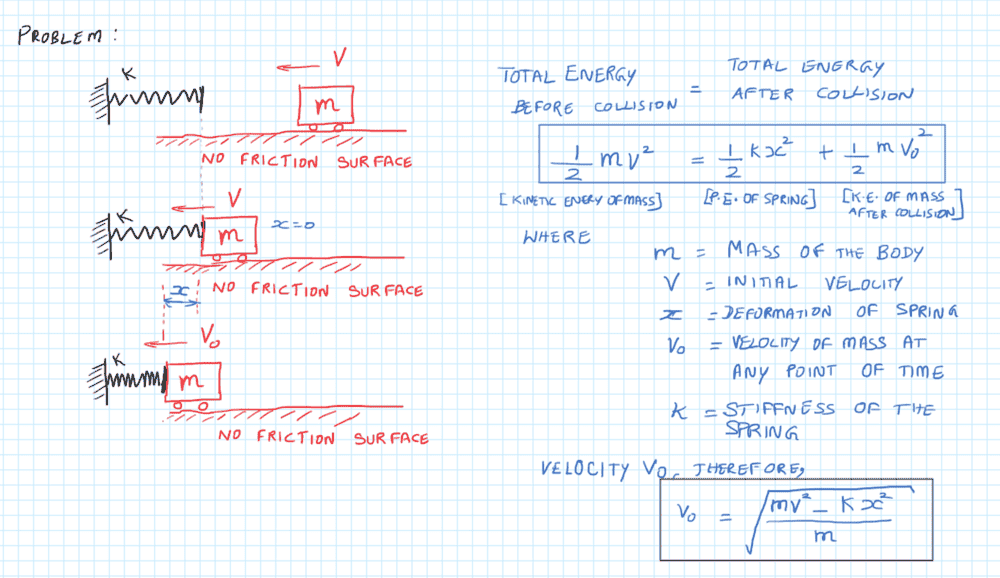 As you can find, I am able to find the velocity of the object at any 'x' value after collision. I am also able to figure out the max. 'x' value by equating kinetic energy of the mass on RHS of the equation to zero. I am unable to find out the following though:
1. How to find the position of mass x W.R.R. time?
2. Vo is (dx / dt). I want the acceleration (d2x/dt2). I am out of touch with calculus for a very long time, adding to the fact that maths is my weak subject.
Can someone help me finding the above two points pl.?
Relevant Equations: 1/2 m*V^2 = 1/2*k*x^2 + 1/2*m*(Vo)^2
Kinetic energy of mass before collision = Potential energy of spring at an instance + Kinetic energy of mass at the same instance
I am creating a simple mathematical model to understand the impact of a moving object on a sprung system:
1. How to find the position of mass x W.R.R. time?
2. Vo is (dx / dt). I want the acceleration (d2x/dt2). I am out of touch with calculus for a very long time, adding to the fact that maths is my weak subject.
Can someone help me finding the above two points pl.?