How to find the deceleration of a mass colliding on a spring?

Click For Summary

Homework Help Overview

The discussion revolves around a mass colliding with a spring, focusing on the deceleration of the mass and the equations governing the system. Participants are exploring the relationship between kinetic and potential energy in the context of a spring-mass system.

Discussion Character

  • Exploratory, Conceptual clarification, Mathematical reasoning

Approaches and Questions Raised

  • The original poster attempts to derive the position of the mass with respect to time and seeks to understand how to calculate acceleration. Some participants suggest using Newton's second law and the spring force equation, while others note the challenges of solving the differential equation involved.

Discussion Status

Participants are actively discussing the problem, with hints and suggestions being offered regarding the use of differential equations and simple harmonic motion. There is acknowledgment of confusion regarding variable notation, but no consensus has been reached on a specific method to solve the problem.

Contextual Notes

The original poster expresses difficulty with calculus, which may impact their ability to engage with the mathematical aspects of the problem. There is also mention of the need for clarification on variable notation.

k.udhay
Messages
167
Reaction score
13
Homework Statement
A known mass at a know velocity collides on a spring of known stiffness. What is the equation that governs the deceleration of the mass, so that the force on the spring could be found?
Relevant Equations
1/2 m*V^2 = 1/2*k*x^2 + 1/2*m*(Vo)^2

Kinetic energy of mass before collision = Potential energy of spring at an instance + Kinetic energy of mass at the same instance
Problem Statement: A known mass at a know velocity collides on a spring of known stiffness. What is the equation that governs the deceleration of the mass, so that the force on the spring could be found?
Relevant Equations: 1/2 m*V^2 = 1/2*k*x^2 + 1/2*m*(Vo)^2

Kinetic energy of mass before collision = Potential energy of spring at an instance + Kinetic energy of mass at the same instance

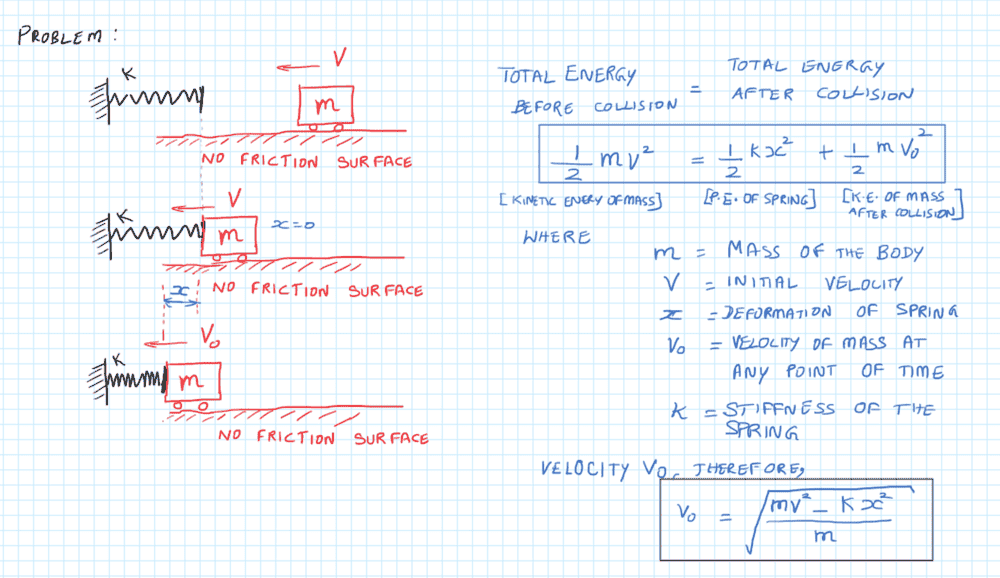
I am creating a simple mathematical model to understand the impact of a moving object on a sprung system:
244482
As you can find, I am able to find the velocity of the object at any 'x' value after collision. I am also able to figure out the max. 'x' value by equating kinetic energy of the mass on RHS of the equation to zero. I am unable to find out the following though:

1. How to find the position of mass x W.R.R. time?
2. Vo is (dx / dt). I want the acceleration (d2x/dt2). I am out of touch with calculus for a very long time, adding to the fact that maths is my weak subject.

Can someone help me finding the above two points pl.?
 
Physics news on Phys.org
How to find the position of mass x W.R.R. time"
You use Newton: ##F = ma ## in combination with the (ideal) spring equation ##F = - kx##
 
  • Like
Likes   Reactions: k.udhay
BvU said:
You use Newton: ##F = ma ## in combination with the (ideal) spring equation ##F = - kx##
But I don't know either acceleration or x. All I know is the time t.
 
Hint: F=##\text{m} d^2 x/dt^2 =\text{-kx} ##
 
  • Like
Likes   Reactions: k.udhay
k.udhay said:
I am out of touch with calculus for a very long time
Then you are unlikely to be able to solve the differential equation. Have you heard of simple harmonic motion?
Plug in the solution ##x=A\sin(\omega t)##, where A and ω are unknown constants and see what happens.

By the way, your use of v and v0 is confusing. Usual is to have the unsubscripted form for the generic variable and the subscript to denote a particular value of it.
 
  • Like
Likes   Reactions: k.udhay
haruspex said:
Then you are unlikely to be able to solve the differential equation. Have you heard of simple harmonic motion?
Plug in the solution ##x=A\sin(\omega t)##, where A and ω are unknown constants and see what happens.

By the way, your use of v and v0 is confusing. Usual is to have the unsubscripted form for the generic variable and the subscript to denote a particular value of it.
Yes, I later realized I should have given the subscripts correctly.
 

Similar threads

Replies
17
Views
2K
  • · Replies 5 ·
Replies
5
Views
2K
Replies
29
Views
3K
Replies
1
Views
1K
Replies
9
Views
2K
  • · Replies 12 ·
Replies
12
Views
3K
  • · Replies 3 ·
Replies
3
Views
2K
Replies
24
Views
4K
  • · Replies 15 ·
Replies
15
Views
2K
Replies
8
Views
6K