How to Find the Generalized Eigenvector in a Matrix ODE?

Click For Summary

Discussion Overview

The discussion revolves around finding generalized eigenvectors in the context of a matrix ordinary differential equation (ODE). Participants explore the relationship between algebraic and geometric multiplicities of eigenvalues, the calculation of eigenvectors, and the implications of Jordan normal forms.

Discussion Character

  • Exploratory
  • Technical explanation
  • Debate/contested
  • Mathematical reasoning

Main Points Raised

  • Alwar seeks assistance in finding generalized eigenvectors using the algorithm (A-λI)w=v, expressing difficulty in obtaining the eigenvector matrix M.
  • Some participants express confusion regarding the eigenvalues, noting discrepancies between the stated eigenvalues and those found in the Jordan normal form.
  • There are requests for clarification on the specific problems encountered in calculating eigenvectors, with some participants questioning whether generalized eigenvectors can be set aside initially.
  • Participants discuss the implications of degenerate eigenvalues and the freedom in choosing eigenvectors, suggesting that multiple orthogonal eigenvectors can be selected.
  • One participant describes a method for finding a specific eigenvector that allows for the construction of a Jordan chain, emphasizing that it is not a random vector but one that satisfies the system.
  • There are mentions of typos in the original attachments, particularly regarding the eigenvalues and the Jordan matrix.
  • Vela shares a method of finding eigenvectors through augmented matrices and row reduction, but later states that they cannot provide their calculations as they were done in Mathematica without saving the notebook.

Areas of Agreement / Disagreement

Participants express confusion and disagreement regarding the eigenvalues and the calculation of eigenvectors. There is no consensus on the correct interpretation of the eigenvalues or the method for finding the generalized eigenvectors, indicating multiple competing views remain.

Contextual Notes

Limitations include potential typos in the original problem statement, unresolved mathematical steps in finding eigenvectors, and the dependence on specific definitions of eigenvalues and eigenvectors in the context of the discussion.
Alwar
Messages
5
Reaction score
1
TL;DR
To find the generalized eigenvectors of a 6x6 matrix
Hi,

I have a set of ODE's represented in matrix format as shown in the attached file. The matrix A has algebraic multiplicity equal to 3 and geometric multiplicity 2. I am trying to find the generalized eigenvector by algorithm (A-λI)w=v, where w is the generalized eigenvector and v is the eigenvector found by (A-λI)v=0. But I am not able to get the eigenvector matrix M as shown in the attached file.

Any help could be useful.Thanks,
Alwar
 

Attachments

  • Like
Likes   Reactions: Delta2
Physics news on Phys.org
I'm a little confused, it says the eigenvalues are ##\pm k^2## but then the Jordan normal form only has ##\pm k## on the diagonal. Aren't the diagonal elements supposed to be the eigenvalues?
 
Would you be a little more specific about the problem you're having? You say you can't find the matrix of eigenvectors. Does that mean you are unable to calculate any particular eigenvector? If I understand your question, we can set aside the generalized eigenvectors for now, correct?
 
Office_Shredder said:
I'm a little confused, it says the eigenvalues are ##\pm k^2## but then the Jordan normal form only has ##\pm k## on the diagonal. Aren't the diagonal elements supposed to be the eigenvalues?
This is the part of a manuscript published in the journal. I think they have mentioned eigenvalues wrongly as k^2. When I calculated its only k. I hope the Jordan matrix is correct.

Thanks.
 
Haborix said:
Would you be a little more specific about the problem you're having? You say you can't find the matrix of eigenvectors. Does that mean you are unable to calculate any particular eigenvector? If I understand your question, we can set aside the generalized eigenvectors for now, correct?
Thanks Haborix. Inspecific, I cannot find the first and sixth column of eigenvectors in matrix M. But when I find the characteristic equation (A-λI)X = 0 for each of the eigenvalue, both these vectors satisfy the solution upon back substitution. But I cannot find them directly. Or the authors have taken any random vector?
 
Haborix said:
Would you be a little more specific about the problem you're having? You say you can't find the matrix of eigenvectors. Does that mean you are unable to calculate any particular eigenvector? If I understand your question, we can set aside the generalized eigenvectors for now, correct?
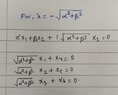
For λ = -sqrt(α^2+β^2), solving the characteristic equation in the matlab, the fourth column vector in M is displayed as solution. However if we manually do, we can get four equations as shown in the attached figure. And the first equation repeats three times meaning infinite solutions. The sixth column vector will satisfy the solution. But is it just a random vector? Or can it be attained as a solution.
 

Attachments

  • IMG_20210730_160242.jpg
    IMG_20210730_160242.jpg
    42.2 KB · Views: 223
When you have degenerate eigenvalues you usually pick three eigenvectors such that they are all mutually orthogonal. I think there are some typos in your original attachment in post #1. In a few instances if a ##k## were a ##k^2## then two eigenvectors would be orthogonal. The big picture message is that there is freedom in choosing the eigenvectors for a given eigenvalue with when its multiplicity greater than 1.
 
Alwar said:
But is it just a random vector? Or can it be attained as a solution.
I solved for the two eigenvectors ##\vec v_1, \vec v_2## for ##\lambda = -k## the usual way, and I found that the system ##(A-\lambda I)\vec x = \vec v_i## was inconsistent for both eigenvectors. But that was okay because any linear combination of the two is still an eigenvector, and there is one that results in a system with a solution, namely the sixth column of ##M##. So it's not a random vector, but the one that allows you to calculate a Jordan chain.

I found the vector by setting up an augmented matrix where the seventh column was a linear combination of the two eigenvectors and row-reduced until I ended up with a row of zeros in the left six columns. Then I solved for coefficients that caused the corresponding value in the seventh column to vanish.

By the way, I noticed a typo: the bottom diagonal element of ##J## should be ##-k##, not ##k##.
 
vela said:
I solved for the two eigenvectors ##\vec v_1, \vec v_2## for ##\lambda = -k## the usual way, and I found that the system ##(A-\lambda I)\vec x = \vec v_i## was inconsistent for both eigenvectors. But that was okay because any linear combination of the two is still an eigenvector, and there is one that results in a system with a solution, namely the sixth column of ##M##. So it's not a random vector, but the one that allows you to calculate a Jordan chain.

I found the vector by setting up an augmented matrix where the seventh column was a linear combination of the two eigenvectors and row-reduced until I ended up with a row of zeros in the left six columns. Then I solved for coefficients that caused the corresponding value in the seventh column to vanish.
Hi Vela,

Thanks for your effort. Can you upload the solution of how you got the sixth column of eigenvector. I hope I will be able to grasp what you have done.
 
  • #10
Sorry, no. I did the calculations using Mathematica and didn't save the notebook.
 
  • Wow
Likes   Reactions: Delta2
  • #11
Alwar said:
Hi Vela,

Thanks for your effort. Can you upload the solution of how you got the sixth column of eigenvector. I hope I will be able to grasp what you have done.
You can probably find a solution using mathworld
 

Similar threads

  • · Replies 12 ·
Replies
12
Views
2K
  • · Replies 3 ·
Replies
3
Views
4K
  • · Replies 4 ·
Replies
4
Views
3K
  • · Replies 14 ·
Replies
14
Views
2K
Replies
3
Views
3K
  • · Replies 4 ·
Replies
4
Views
6K
Replies
2
Views
4K
  • · Replies 2 ·
Replies
2
Views
3K
  • · Replies 6 ·
Replies
6
Views
2K
  • · Replies 19 ·
Replies
19
Views
4K