How to Glue the Hyperbolic Plane to Form Klein's Quartic?

  • Context: Graduate 
  • Thread starter Thread starter Lapidus
  • Start date Start date
Click For Summary

Discussion Overview

The discussion revolves around the process of gluing the hyperbolic plane to form Klein's quartic, a surface of genus 3. Participants explore the necessary cuts and edge identifications required to achieve this topological transformation, referencing symmetries and Euler characteristics.

Discussion Character

  • Exploratory
  • Technical explanation
  • Conceptual clarification
  • Debate/contested

Main Points Raised

  • One participant inquires about the specific method to glue the hyperbolic plane to create Klein's quartic, noting a lack of description in the referenced image.
  • Another participant suggests that creating the Klein quartic involves making at least 6 loop cuts to transform it into a topologically equivalent disc, but questions how to reconcile this with the 14 edges depicted in the image.
  • A different participant references John Baez's work, indicating that the problem may be complex and beyond their understanding.
  • One participant provides a link that describes the gluing process but expresses confusion over the number of loop cuts, suggesting that not all cuts can be loop cuts without separating the disc.
  • Another participant calculates the Euler characteristic for the Klein quartic, confirming its genus and deriving the number of vertices after edge identification.
  • A subsequent post clarifies that the last cut along the edge connecting the two distinct vertices is not a loop cut.
  • It is noted that all 7 "cuts" are actually between the two vertices, suggesting a distinction in terminology regarding edges versus cuts.

Areas of Agreement / Disagreement

Participants express uncertainty about the nature of the cuts and the identification of edges, indicating that there is no consensus on how to accurately describe the gluing process for Klein's quartic.

Contextual Notes

Participants highlight limitations in understanding the relationship between the number of cuts, edges, and vertices, as well as the implications of the symmetries of Klein's quartic on the gluing process.

Lapidus
Messages
344
Reaction score
12
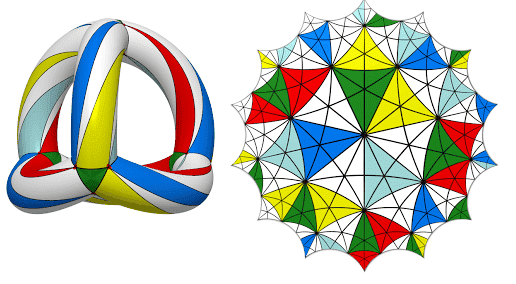
Can someone tell me how I have to glue together the hyperbolic plane
so that I get the surface (Klein's quartic) shown to the left. I found this picture on the net, but without a desription how to glue.
thanks!
Unbenannt.PNG
 
Physics news on Phys.org
this is a fun question. i don't know the answer but it is fun staring at the pictures. since the klein quartic is a surface of genus 3, one must mnake a minimum of 6 loop cuts to render it topologically a disc as in th picture. but there are 14 edges to the disc in the picture. this has something to do with th symmetries of the klein quartic which has symmetries of orders 2,3, 7, so the decomposition is done in a way that respects these symmetries. e.g. rotation of order 7 about the center gives one of the automorphisms of the quartic, but i don't quite see how to glue it back together.
 
this is a nice link with a description of how to glue, but it puzzles me since again making more than 6 loops cuts would separate the disc, so somehow those cuts are not all loop cuts?
 
Since the genus of a g-holed torus is g, the Klein quartic has genus 3, and hence Euler characteristic 2 - 2g = -4.

After identifying the edges in pairs, there will be 1 2-cell, 7 edges, and say V vertices.

The alternating sum 1 - 7 + V is the Euler characteristic, so we have

1 - 7 + V = -4​

and so

V = 2.​

The reason that the number of cuts seemed too many is that there will be 2 vertices after identification, not just 1.
 
  • Like
Likes   Reactions: jim mcnamara
equivalently the last cut along the edge joining the two distinct vertices is not a loop cut.
 
In fact, all 7 "cuts" are between the two vertices. Though it is better to call them edges.
 
Last edited:

Similar threads

  • · Replies 22 ·
Replies
22
Views
8K
  • · Replies 38 ·
2
Replies
38
Views
8K
  • · Replies 1 ·
Replies
1
Views
1K
Replies
7
Views
3K
  • · Replies 6 ·
Replies
6
Views
2K
  • · Replies 10 ·
Replies
10
Views
2K
  • · Replies 10 ·
Replies
10
Views
4K
  • · Replies 3 ·
Replies
3
Views
2K
  • · Replies 14 ·
Replies
14
Views
2K
  • · Replies 1 ·
Replies
1
Views
1K