How to Identify Fluorapatite in XRD Analysis?

  • Thread starter Thread starter pink diamond
  • Start date Start date
  • Tags Tags
    Xrd
Click For Summary

Discussion Overview

The discussion revolves around identifying fluorapatite in a sample analyzed through X-ray diffraction (XRD). Participants explore methods for interpreting XRD data, specifically focusing on peak identification and comparison with known standards.

Discussion Character

  • Exploratory, Technical explanation, Debate/contested

Main Points Raised

  • One participant inquires about how to determine the presence of fluorapatite from XRD peaks at various 2θ degrees.
  • Another participant suggests consulting literature for the relationship between angle and energy, as well as expected energies from different elements.
  • A similar suggestion is reiterated by another participant, indicating a potential emphasis on literature review for peak identification.
  • One participant questions the absence of a standard diffraction pattern for comparison when searching for apatite.

Areas of Agreement / Disagreement

The discussion contains multiple viewpoints regarding the identification process, and no consensus is reached on the best approach to confirm the presence of fluorapatite.

Contextual Notes

Participants do not specify the exact standards or literature references, and there is no mention of the specific peaks associated with fluorapatite.

Who May Find This Useful

Researchers and students involved in mineralogy, materials science, or analytical chemistry, particularly those working with XRD analysis.

pink diamond
Messages
3
Reaction score
0
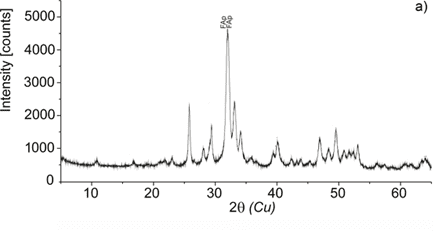
I have a sample that was analyzed with x-ray diffraction, the graph had several peaks at different 2θ degrees, how to know if this sample has fluorapatite? I need the answer ASAP please..
upload_2017-4-8_17-35-37.png
 
Engineering news on Phys.org
You can look up the relation between angle and energy in the literature, and you can also look up the expected energies from different elements.
 
  • Like
Likes   Reactions: pink diamond
mfb said:
You can look up the relation between angle and energy in the literature, and you can also look up the expected energies from different elements.
thanks for responding,,, I'll give it a try
 
If you're looking for apatite, then why don't you have a standard diffraction pattern to compare it to?
 

Similar threads

Replies
2
Views
2K
Replies
7
Views
11K
  • · Replies 1 ·
Replies
1
Views
2K
  • · Replies 5 ·
Replies
5
Views
7K
  • · Replies 1 ·
Replies
1
Views
6K
  • · Replies 2 ·
Replies
2
Views
2K
  • · Replies 1 ·
Replies
1
Views
3K
Replies
3
Views
14K
  • · Replies 1 ·
Replies
1
Views
2K
  • · Replies 5 ·
Replies
5
Views
19K