Undergrad How to integrate d2x/dt2 with respect to x?

  • Thread starter Thread starter Max Loo Pin Mok
  • Start date Start date
  • Tags Tags
    Integrate
Click For Summary
SUMMARY

The discussion focuses on the integration of the kinetic energy equation in a mass-spring system as described in chapter 3 of "Vibrations and Waves" by French. The user seeks clarification on how equation (3-1) transitions to equation (3-2) through differentiation and integration with respect to displacement x. The correct application of the chain rule is emphasized, specifically how to derive the first derivative of \( f^2 \) with respect to time t, where \( f = \frac{dx}{dt} \). The conclusion highlights the importance of understanding the relationship between velocity and acceleration in this context.

PREREQUISITES
  • Understanding of classical mechanics, specifically mass-spring systems.
  • Familiarity with calculus, particularly differentiation and integration.
  • Knowledge of the chain rule in calculus.
  • Basic concepts of kinetic energy in physics.
NEXT STEPS
  • Study the application of the chain rule in calculus.
  • Explore the derivation of kinetic energy equations in classical mechanics.
  • Learn about the equations of motion for mass-spring systems.
  • Investigate the relationship between velocity, acceleration, and displacement in physics.
USEFUL FOR

Students of physics, educators teaching classical mechanics, and anyone studying the mathematical foundations of motion in mass-spring systems.

Max Loo Pin Mok
Messages
5
Reaction score
7
TL;DR
About the mass-spring system.
Can we derive one equation of motion from another?
In chapter 3 of Vibrations and Waves by French, there is a description about the equations of motion of a mass-spring system. It was written as shown in the attached picture:
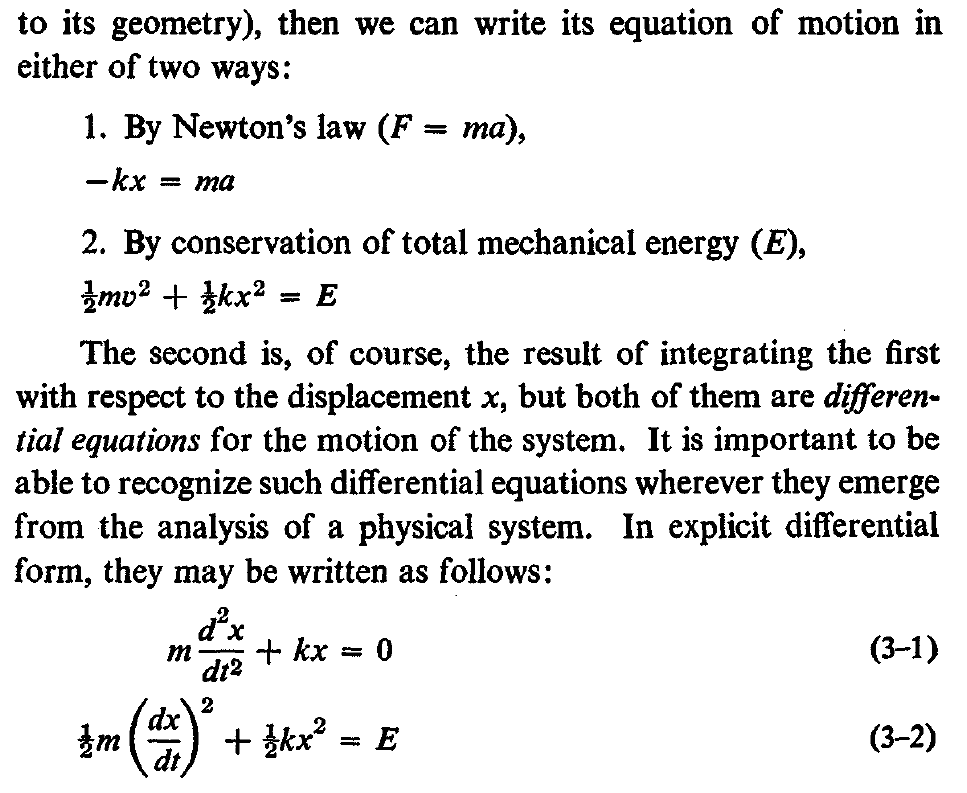
Equation of Motions.png

Here, m is the mass on the spring, k is the spring constant, x is the extension of the spring, and t is time. My problem is about figuring out how equation (3-1) becomes equation (3-2)? I tried to differentiate 1/2 m(dx/dt)2:
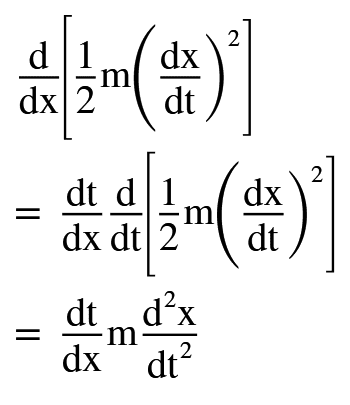
equation 2.png

I got an extra dt/dx which is not there in equation (3-1). Is my working wrong or is there another way of understanding what is in the textbook: "The second is, of course, the result of integrating the first with respect to the displacement x ..."?
 
Physics news on Phys.org
You are not calculating correctly the derivative $$\frac{d}{dt}\frac{1}{2}m(\frac{dx}{dt})^2$$

if ##f## is a function of ##t##, what is the first derivative of ##f^2##? (w.r.t to ##t##). Then apply this for ##f=\frac{dx}{dt}##
 
Last edited:
According to the chain rule, you have
$$a = \frac{dv}{dt} = \frac{dv}{dx} \frac{dx}{dt} = v \frac{dv}{dx},$$ where ##v = dx/dt##.
 
Relativistic Momentum, Mass, and Energy Momentum and mass (...), the classic equations for conserving momentum and energy are not adequate for the analysis of high-speed collisions. (...) The momentum of a particle moving with velocity ##v## is given by $$p=\cfrac{mv}{\sqrt{1-(v^2/c^2)}}\qquad{R-10}$$ ENERGY In relativistic mechanics, as in classic mechanics, the net force on a particle is equal to the time rate of change of the momentum of the particle. Considering one-dimensional...

Similar threads

  • · Replies 6 ·
Replies
6
Views
2K
  • · Replies 4 ·
Replies
4
Views
3K
  • · Replies 6 ·
Replies
6
Views
3K
  • · Replies 20 ·
Replies
20
Views
4K
  • · Replies 3 ·
Replies
3
Views
2K
  • · Replies 5 ·
Replies
5
Views
4K
  • · Replies 8 ·
Replies
8
Views
2K
  • · Replies 19 ·
Replies
19
Views
4K
  • · Replies 3 ·
Replies
3
Views
3K
  • · Replies 3 ·
Replies
3
Views
2K