How to make a plot on an experimental figure

1 reply · 2K views · last reply
Safinaz
Messages
255
Reaction score
8
Hi all,

What is the tool which can add my Listplot graph like:
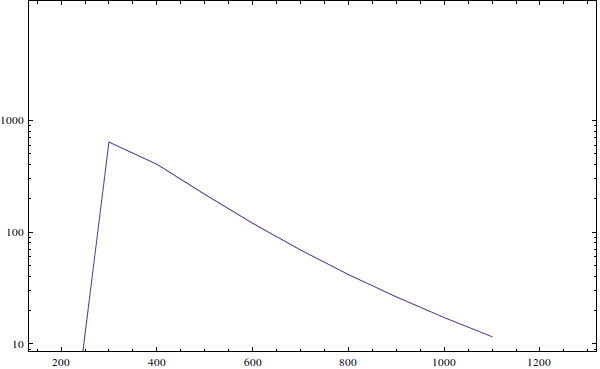
Log-scale line plot in Mathematica style: a single blue line rises sharply near x = 300, peaks near 600 on the y-axis, then falls steadily to about 12 at x = 1100. Y-axis labels 10, 100, 1000; x-axis 200 to 1200.


to an experimental figure as following: such that the (x-y) axes coincidence in both figure and graph:
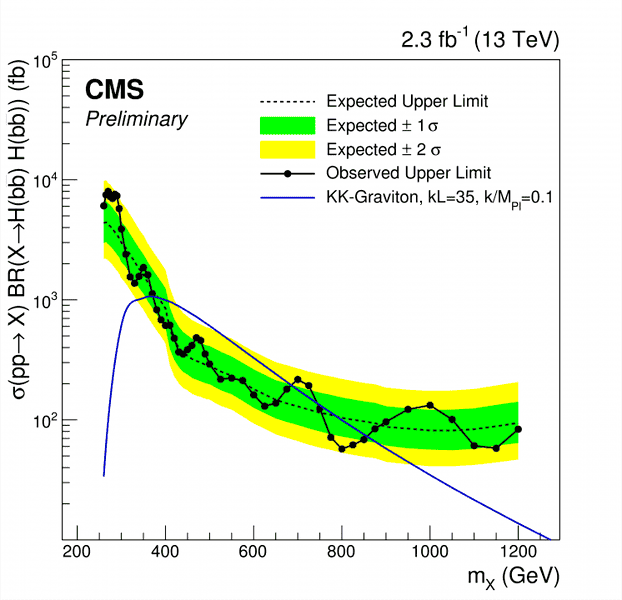
Log-scale plot of CMS 2.3 fb-1 (13 TeV) cross-section limits versus mX (GeV) from 200 to 1200, with observed and expected upper limits, green and yellow bands, and a blue KK-Graviton curve peaking near 350 GeV.

Actually I tried Mathematica as:

Code:
data27 = Import["~/Events/scan.dat"];
idata27 = Table[{data27[[i, 2]], data27[[i, 3]]*10^3}, {i, 1,Length[data27]}];
sh = Show[
  ListLogPlot[idata27, Axes -> True, Frame -> True, Joined -> True],
  PlotRange -> {{150, 1300}, {Log[10], Log[10000]}}, ImageSize -> 600]

mm = Import["~/Desktop/search/CMS-PAS-HIG-16-002_Figure_007.png",
  ImageSize -> 600]

Overlay[{mm, sh}, Alignment -> {-0.4, -0.6}]

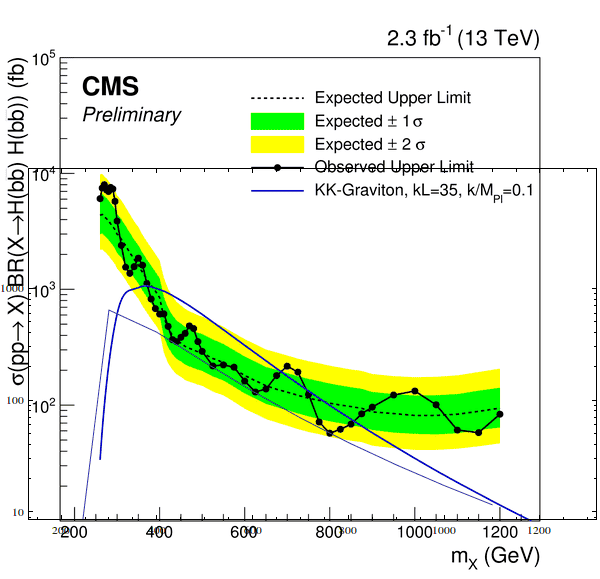
But i ended up by:

CMS experimental plot of sigma(pp to X) times BR(X to H(bb) H(bb)) in fb against m_X in GeV, 2.3 fb-1 at 13 TeV, with observed and expected upper limits and a blue KK-Graviton curve.


So any help to got my graph JUST AS the blue theoretical line appears in the figure ?

Best ..
 
Attachments
  • Log-scale plot of CMS 13 TeV search: cross section times branching ratio (fb) versus m_X (GeV), 200 to 1200, with observed limit points, expected limit band, and blue KK-Graviton curve.
    Figure.png
    20.4 KB · Views: 541
  • CMS preliminary plot of sigma(pp to X) times BR(X to H(bb) H(bb)) in fb against resonance mass m_X from 200 to 1200 GeV, with observed and expected upper limits and a KK-graviton curve.
    scanMG.png
    26.1 KB · Views: 584
You'll need ideally the ROOT file used to make the CMS plot, or alternatively some program that can analyze the existing image and figure out where the axes are. There are tools that can do that, but I don't know them. Once you have that you can scale your data to figure out the coordinates of your lines, and add those to the image.
 
  • Like
Likes   Reactions: Safinaz