How to motivate ‘unless’ = ‘if not’, with etymology?

  • Context: Graduate 
  • Thread starter Thread starter scherz0
  • Start date Start date
  • Tags Tags
    Logic
Click For Summary

Discussion Overview

The discussion centers on the motivations for equating "unless" with "if not," particularly through etymological perspectives. Participants explore how to effectively teach this concept, considering both linguistic history and pedagogical strategies in mathematics and logic.

Discussion Character

  • Debate/contested
  • Conceptual clarification
  • Meta-discussion

Main Points Raised

  • One participant seeks a simpler, etymological motivation for "unless" equating to "if not," referencing historical linguistic developments.
  • Another participant argues that focusing on etymology in teaching is a waste of time, suggesting that definitions should stand independently in proofs.
  • A participant compares mathematical expressions using "unless" and "if not" to illustrate the equivalence in context.
  • Some participants express skepticism about the usefulness of etymology in teaching, citing experiences where preconceived notions hinder understanding.
  • One participant emphasizes that etymology may lead to confusion in mathematics, advocating for a focus on definitions instead.
  • A humorous reference to Humpty Dumpty highlights the subjective nature of word meanings, suggesting that historical meanings may not apply in mathematical contexts.
  • Another participant reiterates the importance of definitions over etymological explanations in mathematics and logic education.

Areas of Agreement / Disagreement

Participants express differing views on the relevance of etymology in teaching the concept of "unless" as "if not." Some advocate for its inclusion, while others argue against it, leading to an unresolved debate on the best pedagogical approach.

Contextual Notes

Participants highlight the potential for confusion arising from historical meanings of words in mathematics, suggesting that definitions may be more critical than etymological insights.

scherz0
Messages
6
Reaction score
1
My students still reckon Lande’s 2 motivations for ‘unless’ = ‘if not’ (below) too abstract, formalistic! Thus I need a 3rd simpler, motivation with merely etymology. But I never studied linguistics! How do I

1. use these etymology quotations, to motivate ‘unless’ = ‘if not’?

2. teach why “less than” means 'if not'?

We turn now to unless. The construction developed toward the end of the Middle English period, in the early fifteenth century. At this stage it is a comparative, lesse than, or in/on/of lesse than.

Traugott E.C. (1987) “UNLESS and BUT conditionals: a historical perspective.” In A. Athanasiadou and R. Dirven (eds.), On Conditionals Again. Amsterdam/Philadelphia: John Benjamins, page 145.

By late ME the construction must have become opaque, because we begin to find the forms unless/onless without than. This is presumably in part a folk etymology relating the connective to a negative derivative un- (it can be assumed that the negative inference from the protasis has been lexicalized into, that is, has taken on a morphological form of, the prefix of the conjunction).

Idem, page 156.

As we have seen, unless derives from less than, and un- has no historical origin in a negative.

Id. 157. See also Etymonline.

mid-15c., earlier onlesse, from (not) on lesse (than) "(not) on a less compelling condition (than);" see less.

The first syllable originally was on, but the quality of negation in the word and the lack of stress changed it to un-.

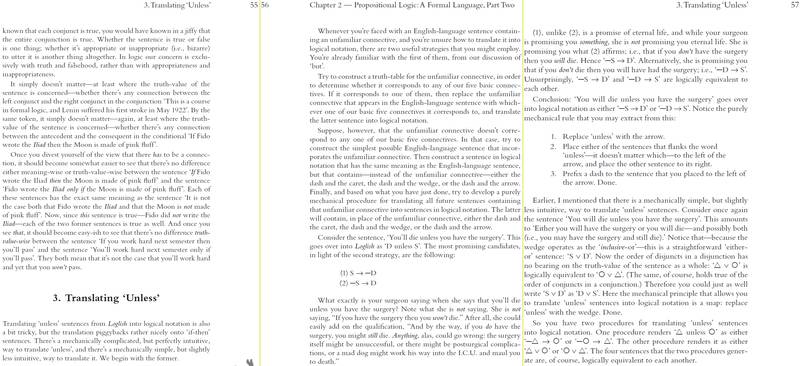
9lInApk.jpg

Lande N.P. Classical logic and its rabbit-holes: A first course (2013), pages 55-7.

In most statements, the word “unless” means if not.

Baronett S. Logic (5th edn 2022), 236

“Unless” is also equivalent to “if not”; so we also could use “(∼B ⊃ D)” (“If you don’t breathe, then you’ll die”).

Gensler H. Introduction to Logic (3 edn 2017), 132.

The word “unless” means “if not”.

[Mentor Note: Obnoxious fonts and colors removed from this post]
 
Last edited by a moderator:
Physics news on Phys.org
Why would you waste any time in class with motivating that with etymology? Just tell them “unless” is defined as “if not” in the context of proofs. Then move on.

You have limited time and lots of important concepts to cover. Not all definitions make sense, even with the etymology. In the end, the definition stands on its own, whether it is well motivated or not.
 
Last edited:
  • Like
Likes   Reactions: Agent Smith, phinds, pbuk and 1 other person
Compare ##x < 0## unless ##x \ge 0##, with ##x <0## if ##x## not ##\ge 0##.
 
Last edited by a moderator:
scherz0 said:
Why didn't you peruse https://matheducators.stackexchange.com/q/26405 linked in my post, on why etymology assists learning vocabulary ?
Did you peruse it? The only answer, with several upvotes, said “I think etymology is not useful in the way proposed by the OP”. And the OP cited no studies supporting the usefulness of etymology in learning or teaching.

I might provide one very brief dissection of an important word. Not two, and certainly not three.

In my opinion you are wasting precious class time, and you should move on.
 
Last edited by a moderator:
  • Like
  • Love
Likes   Reactions: phinds, pbuk and Mark44
scherz0 said:
Why didn't you peruse https://matheducators.stackexchange.com/q/26405 linked in my post, on why etymology assists learning vocabulary ?
In my experience, as far as mathematics and physics is concerned, it's quite the contrary. Many students suffer from preconceived ideas about concepts because of the words that have been adopted. In fact, we have a lot of threads on here where the battle is to get the layperson or student to accept that just because a word means something in everyday life, this does not affect its meaning as defined within physics.
 
  • Like
Likes   Reactions: Dale and pbuk
This post must be in the wrong forum - etymology is nothing to do with mathematics, in mathematics we use definitions. What a word may have meant to anyone before we defined it is at best irrelevant and at worst the source of misunderstanding and confusion.

“When I use a word,” Humpty Dumpty said in rather a scornful tone, “it means just what I choose it to mean—neither more nor less.”
Lewis Carrol: Through the Looking Glass
 
  • Like
  • Haha
Likes   Reactions: phinds, PeroK, pines-demon and 1 other person
Perhaps we could say ...

"John, Jack won't come with you unless you give him $100
We can see here that if not ($100 to Jack) then (John is coming alone). Any amount < $100 implies John is coming alone.
 
Last edited:
  • Like
Likes   Reactions: Hornbein

Similar threads

  • · Replies 19 ·
Replies
19
Views
12K
Replies
15
Views
41K
  • · Replies 38 ·
2
Replies
38
Views
8K
  • · Replies 40 ·
2
Replies
40
Views
8K