jackiepollock
- 11
- 2
- Homework Statement
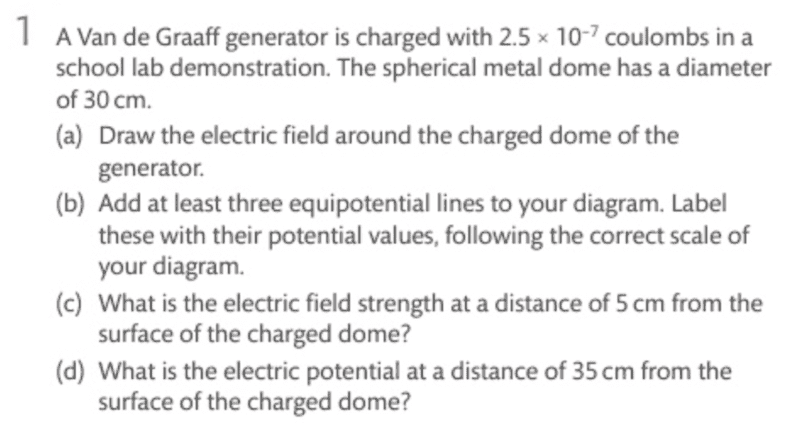
- The problem is asking me to imagine a radial field around a Van de Graaff generator and finding the potential values and electric field strength in varying distances from the surface.
- Relevant Equations
- For electric field strength:E= Q/4πϵ0r^2
For potential :E= Q/4πϵ0r
Hello!
First off, for a), I am not too sure how to picture a radial field around a 3d object. I know that this spherical metal dome is basically a enlarged version of an atom, but since with problems on radial field around an atom, I don't have to consider its diameter, I'm not sure how the diameter of 30cm should make a difference to picturing the radial field.
for b),
The answer says: equipotentials concentric with dome surface; increasing separation of equipotentials; surface voltage is 15 000 V, so equipotential labelling should decrease from that following 1/r relationship. I am not too sure how this 15000V is calculated.
for c)
I tried 8.99 x 10^9 x 2.5 x 10^-7/(0.05)^2, which is 899000 Vm^-1, different from the answer provided, being 56000 Vm^-1. What did I do wrong?
Thank you so much for the help!
First off, for a), I am not too sure how to picture a radial field around a 3d object. I know that this spherical metal dome is basically a enlarged version of an atom, but since with problems on radial field around an atom, I don't have to consider its diameter, I'm not sure how the diameter of 30cm should make a difference to picturing the radial field.
for b),
The answer says: equipotentials concentric with dome surface; increasing separation of equipotentials; surface voltage is 15 000 V, so equipotential labelling should decrease from that following 1/r relationship. I am not too sure how this 15000V is calculated.
for c)
I tried 8.99 x 10^9 x 2.5 x 10^-7/(0.05)^2, which is 899000 Vm^-1, different from the answer provided, being 56000 Vm^-1. What did I do wrong?
Thank you so much for the help!