How to Prove This Hermitian Operator Statement?

Click For Summary

Homework Help Overview

The discussion revolves around proving a statement related to Hermitian operators in quantum mechanics, specifically involving a Hermitian operator A and a complete set of functions {|Ψi>}. The original poster seeks assistance in proving a mathematical relation involving these elements.

Discussion Character

  • Exploratory, Conceptual clarification, Mathematical reasoning

Approaches and Questions Raised

  • The original poster attempts to use the definition of standard deviation and the hermicity of operator A but encounters difficulties. Some participants suggest leveraging the completeness relation of the basis functions and the properties of summation to clarify the terms involved.

Discussion Status

Participants are actively engaging with the original poster's attempts, providing insights into the properties of the completeness relation and the implications of summing over indices. There is an ongoing exploration of the mathematical relationships without a clear consensus yet.

Contextual Notes

There is a note of language barrier from the original poster, which may affect their understanding and expression of the problem. The discussion also highlights the importance of the completeness relation in the context of the proof.

abcs22
Messages
11
Reaction score
0
1. Homework Statement prove the following statement:
Hello, can someone help me prove this statement
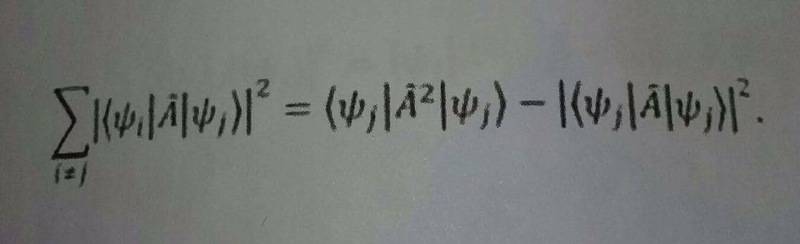
PzXRBBp.jpg


A is hermitian and {|Ψi>} is a full set of functions

Homework Equations


Σ<r|A|s> <s|B|c>[/B]

The Attempt at a Solution


Since the right term of the equation reminds of the standard deviation, I tried using its definition but it didn't yield any results. Also, I tried to use the hermicity of the operator A to get the complete set but after that I got stuck.
 
Physics news on Phys.org
This is prety simple if you assume ##\psi_i## form a basis for the Hilbert space of states. Just use the complex relation ##|z|^2=z z^*## for the left hand side, and use the completeness relation for ##\psi_i##. Is this what you meant by a full set of functions?
 
Yes, I did, I apologize, English is not my mother language. I tried but I can't get those two terms on the right side
 
abcs22 said:
Yes, I did, I apologize, English is not my mother language. I tried but I can't get those two terms on the right side
No problem. The two terms come as a property of the summation. The completeness relation assumes you sum over all ##i##. The first term comes from the completeness relation. The second term comes from the fact that you are missing the ##i=j## in the summation on the left hand side. The key equation you need to use is
$$
\langle \psi_j | A^2 | \psi_j \rangle=\sum_i \langle \psi_j | A | \psi_i \rangle \langle \psi_i | A | \psi_j \rangle
$$
 

Similar threads

  • · Replies 4 ·
Replies
4
Views
4K
  • · Replies 11 ·
Replies
11
Views
4K
  • · Replies 4 ·
Replies
4
Views
3K
Replies
8
Views
3K
  • · Replies 6 ·
Replies
6
Views
10K
  • · Replies 2 ·
Replies
2
Views
3K
  • · Replies 1 ·
Replies
1
Views
2K
Replies
1
Views
6K
  • · Replies 3 ·
Replies
3
Views
2K
  • · Replies 12 ·
Replies
12
Views
4K