How to remove a seized toilet tank bolt?

  • Context: Plumbing 
  • Thread starter Thread starter arabianights
  • Start date Start date
Click For Summary
SUMMARY

This discussion provides effective methods for removing a seized toilet tank bolt, particularly focusing on the use of penetrating oils like Liquid Wrench and Kroil, and techniques involving two nuts to create a temporary head for increased torque. Participants recommend using a wrench to grip the top nut while turning the butterfly fastener, and suggest applying heat with boiling water or a blow torch to loosen the threads. Alternative methods include using an impact driver, vice grip pliers, or, as a last resort, a Dremel tool for cutting the bolt.

PREREQUISITES
  • Understanding of basic plumbing components, specifically toilet tank assembly
  • Familiarity with tools such as wrenches, pliers, and screwdrivers
  • Knowledge of penetrating oils like Liquid Wrench and Kroil
  • Experience with heat application techniques for loosening rusted components
NEXT STEPS
  • Research the effectiveness of different penetrating oils for rusted bolts
  • Learn about using impact drivers for stubborn fasteners
  • Explore safe heat application methods for loosening seized bolts
  • Investigate the use of Dremel tools for cutting and drilling in tight spaces
USEFUL FOR

This discussion is beneficial for DIY enthusiasts, plumbers, and maintenance professionals dealing with plumbing repairs, particularly those facing challenges with rusted or seized toilet tank bolts.

arabianights
Messages
67
Reaction score
8
greetings

I replaced my bedroom toilet due to water leak and unable to replace water tank bolt with new ones.

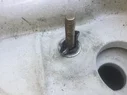
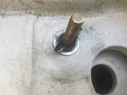
so now i have old toilet in the yard and i took a closer look at the seized bolt, it seems that the bottom part (a butterfly fastener) holds onto the bolt really tight, when i turned the head inside the tank with flathead screwdriver, the fastener moves with the bolt as the whole.

is there a way to remove the bolt?
 

Attachments

  • IMG_5615.webp
    IMG_5615.webp
    73.8 KB · Views: 34
  • IMG_5614.webp
    IMG_5614.webp
    87.3 KB · Views: 13
Physics news on Phys.org
Screw two nuts lightly together near the top. Put a wrench on the top one when you try to turn the butterfly fastener and it should bite into the second nut enough to turn the butterfly nut. I would use some WD-40 on it as well.
If the nuts slip, you can try a barbed washer between them.
 
  • Like
  • Informative
Likes   Reactions: russ_watters, berkeman, DaveE and 2 others
The reasoning is:

A flat blade screwdriver is not the best for applying torque. You need a temporary head on the threaded fastener, to apply a much greater torque, without damaging the thread.

When two nuts are locked tightly together on a threaded bolt or stud, they form a temporary head that can apply a greater torque to the threaded fastener.

Use two wrenches, held close together in one hand, that will tighten the lock nuts against each other. That provides a self-tightening handle on the thread, while with your other hand, you can turn the wing-nut with a loose fitting wrench or pliers.

With experience, you will place a flat washer between the locked nuts, which will conveniently keep the two wrenches, aligned and on their respective nuts.

Having a spring, or a barbed washer, between the two locknuts is a disadvantage, as it makes them harder to separate later. That is, unless they are to remain in place on the thread, and you want them to remain locked.
 
  • Like
Likes   Reactions: russ_watters, Borg, DaveE and 1 other person
1) Liquid wrench, or an equivalent penetrating oil (WD40 isn't one, but it's not a bad second choice), while you're reading our comments.
2) Everything @Baluncore said.
3) If you have an impact driver and a deep well socket, that would be a good approach. Align the two stop nuts as described above to fit in the deep socket when jammed. If not, tapping on your wrench a bit can help.
4) Vice gripe pliers on the wingnut. But don't let them use the porcelain toilet for support. Put some rags or wood in there to spread out the force. Or your hand. Try holding it first.
5) Don't crack the porcelain by getting frustrated with hammers, chisels etc. Nothing with a sharp edge or impact on the porcelain.

PS: When you put it back together, put a bit of anti-seize goo on it. Everyone thinks they only have to do this job once. Most of them are wrong.
 
  • Like
Likes   Reactions: russ_watters, BillTre and sophiecentaur
DaveE said:
an equivalent penetrating oil
. . . . and give it 24 hours to penetrate. The photo doesn't show a lot of rust so there can't be a lot sticking the threads.

I trick I have often used successfully is to pour boiling water over the seized piece. I can't imagine that the porcelain of the tank would crack. If not boiling water then a small blow torch flame(applied to the bolt) could loosen the thread.

If a small angle grinder can get in there, you could split the butterfly off or you could cut the bolt and drill down inside the bound thread. Or drill through from the other end of the bolt. Endless fun.
 
  • Like
Likes   Reactions: gmax137, BillTre and DaveE
sophiecentaur said:
If a small angle grinder
A Dremel tool and an hour of patience. Yes, this is the last resort. I'll bet it's unnecessary.
 
Penetrating oil (I favor Kroil myself) and time, with some gentle heating. If that doesn't work, destructive means may be called for. Heavy wrenching will likely deform the bolt threads, necessitating replacement anyway. A wing nut in a liquid state has no holding power.
 
  • Like
Likes   Reactions: sophiecentaur

Similar threads

  • · Replies 4 ·
Replies
4
Views
647
  • · Replies 8 ·
Replies
8
Views
4K
  • · Replies 16 ·
Replies
16
Views
7K
  • · Replies 39 ·
2
Replies
39
Views
15K
Replies
32
Views
7K
  • · Replies 6 ·
Replies
6
Views
2K
  • · Replies 17 ·
Replies
17
Views
3K
  • · Replies 20 ·
Replies
20
Views
5K
  • · Replies 19 ·
Replies
19
Views
8K
Replies
2
Views
2K