How to Solve a Mixed 2 DOF Vibration Problem with Incorrect Free Body Diagram?

Click For Summary

Homework Help Overview

The discussion revolves around a mixed 2DOF vibration problem involving a lever and linear dynamics. The original poster expresses difficulty with the free body diagram (FBD) and its impact on the differential equations of motion.

Discussion Character

  • Exploratory, Assumption checking, Problem interpretation

Approaches and Questions Raised

  • Participants discuss the setup of the equations of motion and question the horizontal displacements of the springs involved. There is a focus on the correct application of distances related to the pivot and the signs in the equations.

Discussion Status

Some participants have provided guidance on the correct distances for the springs and have pointed out inconsistencies in the signs used in the equations. The conversation is ongoing, with multiple interpretations being explored regarding the setup of the problem.

Contextual Notes

There is mention of specific distances for the springs as given in the problem statement, which may influence the setup of the equations. The participants are also considering the implications of these distances on the overall interpretation of the problem.

Matthias85
Messages
18
Reaction score
0
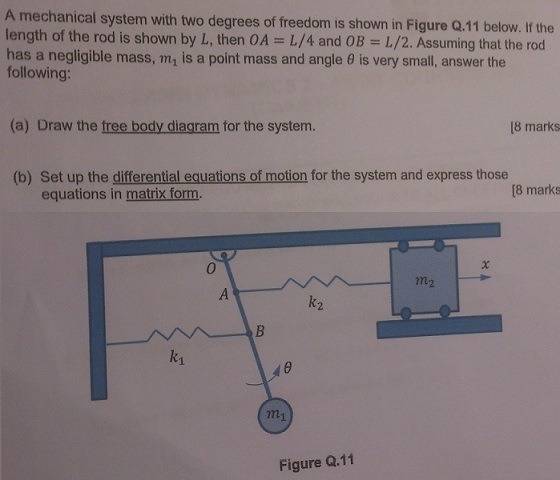
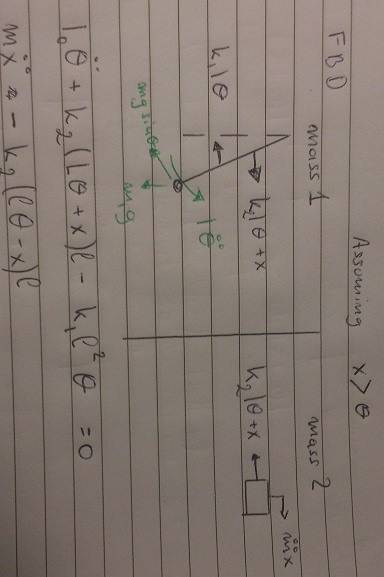
I am struggling with the following question, it is a mixed (lever and linear) 2DOF vibration problem, something I never came across before. I am afraid I am missing something on the FBD, thus the differential equations of motions are wrong.
Homework Statement


attachment.php?attachmentid=72315&stc=1&d=1408577741.jpg


Homework Equations


The Attempt at a Solution


Q1_FBD.jpg
 

Attachments

  • Q1.jpg
    Q1.jpg
    24.1 KB · Views: 740
Physics news on Phys.org
You did the right things to set up the equations of motion, but what are the horizontal displacements of the springs ##k_1## and ##k_2##?

They are not attached at a distance ##L## from the pivot, so they are not ##L\theta##.

Also, be careful with the signs. You have the amount of stretch in ##k_1## as ##L\theta +x## in one equation and ##L\theta -x## in the other. They can't both be right!
 
I see, distance L for each spring is given in question, is it k2 (L/4)θ+x and k1(L/2)θ ?

In which case the differential equation of motion become (now with correct signs)
Iθ + k2 (L/4)θ+x - k1(L/2)θ =0
mx - k2 (L/4)θ+x =0
 
Matthias85 said:
I see, distance L for each spring is given in question, is it k2 (L/4)θ+x and k1(L/2)θ ?

The L/2 and L/4 are right.

With θ and x defined as in the diagram in the question, (L/4)θ and x are both positive to the right. So, is the extension of the spring (L/4)θ+x or (L/4)θ-x ?
 

Similar threads

  • · Replies 7 ·
Replies
7
Views
2K
  • · Replies 12 ·
Replies
12
Views
3K
  • · Replies 25 ·
Replies
25
Views
2K
Replies
4
Views
1K
  • · Replies 12 ·
Replies
12
Views
2K
  • · Replies 5 ·
Replies
5
Views
4K
  • · Replies 2 ·
Replies
2
Views
2K
  • · Replies 6 ·
Replies
6
Views
2K
Replies
12
Views
2K
  • · Replies 2 ·
Replies
2
Views
2K