How to solve for q after finding derivative (derived) equation?

  • Thread starter Thread starter noid
  • Start date Start date
  • Tags Tags
    Derivative
Click For Summary
SUMMARY

The discussion centers on solving for the variable q in the derived equation T = 0.5q + 4q^(-1/2) + 9/q. A key insight is the suggestion to substitute q^(-1/2) with w, transforming the equation into a quartic polynomial in w. While this quartic equation theoretically has an analytic solution, its complexity renders it impractical for straightforward use. The conversation highlights the importance of correctly deriving equations and the potential for numerical methods when analytical solutions are too complex.

PREREQUISITES
  • Understanding of polynomial equations and their degrees
  • Familiarity with variable substitution techniques in algebra
  • Knowledge of numerical methods for root finding
  • Basic calculus concepts, particularly derivatives
NEXT STEPS
  • Study quartic equations and their properties
  • Learn about variable substitution methods in algebra
  • Explore numerical root-finding techniques such as Newton's method
  • Review calculus derivatives and their applications in solving equations
USEFUL FOR

Mathematicians, engineering students, and anyone involved in solving complex algebraic equations or applying calculus in practical scenarios.

noid
Messages
8
Reaction score
0
I have started with the formula.

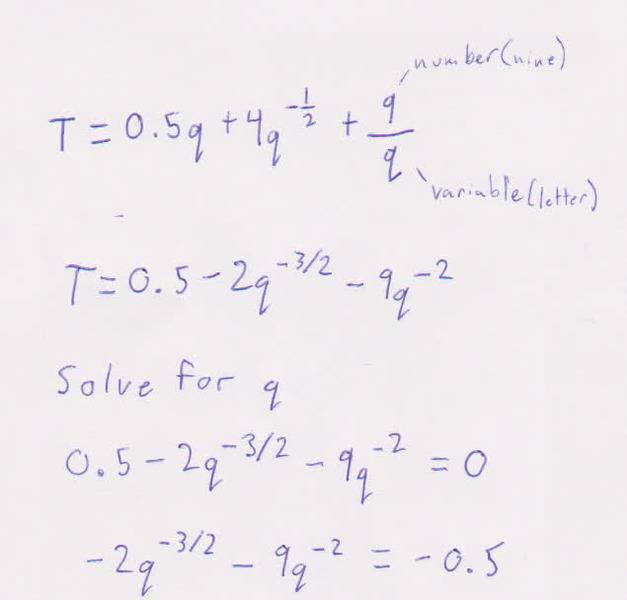
T = 0.5q+4q^(-1/2)+9/q

I have derived and am trying to solve for q but have gotten caught up on how to solve when I have to subtract two variables with different base numbers and different exponents.
2aj3l7q.jpg


Any ideas?
 
Last edited:
Physics news on Phys.org
noid said:
I have started with the formula.

T = 0.5q+4q^(-1/2)+9/q

I have derived and am trying to solve for q but have gotten caught up on how to solve when I have to subtract two variables with different base numbers and different exponents.

2aj3l7q.jpg


Any ideas?

For one thing you made a mistake to start. If you divide both sides by q then the left side should be T/q. The correct way to go is probably to set q^(-1/2)=w, then express the other powers of q in terms w. If you work it through you'll get a quartic equation in w, a polynomial equation with w^4 as the highest power. The good news is that in principle, has a analytic solution. The bad news is that it's so complex as to to be basically useless. Are you sure you haven't made a mistake in deriving the equation you showed us? Where did it come from??
 
Sorry for the misunderstanding: The second line is actually the derivative in respect to q of the first line (I forgot to put ' after T). Then from the second line I want to find what q is (after setting T to 0).
 
noid said:
Sorry for the misunderstanding: The second line is actually the derivative in respect to q of the first line (I forgot to put ' after T). Then from the second line I want to find what q is (after setting T to 0).

Ah, ok. I should have spotted that. If you don't have a T in it then you can still change it into a quartic equation in w. Then you could hope it factors, but I don't think it does. If not you'll just have to find the roots numerically.
 

Similar threads

  • · Replies 7 ·
Replies
7
Views
3K
  • · Replies 3 ·
Replies
3
Views
1K
  • · Replies 1 ·
Replies
1
Views
1K
  • · Replies 3 ·
Replies
3
Views
2K
Replies
1
Views
1K
Replies
9
Views
5K
  • · Replies 1 ·
Replies
1
Views
1K
  • · Replies 6 ·
Replies
6
Views
2K
Replies
3
Views
2K
  • · Replies 7 ·
Replies
7
Views
1K