I suppose that you are referring to the quadratic formula:
The solution to the general quadratic equation: ##ax^2+bx+c=0 ##
is given by ##x = \dfrac{ -b \pm \sqrt{b^2-4ac} }{2a} ##
So, yes, you left the factor of ##a## out of the denominator. In this case ##a=6##.
In addition to what
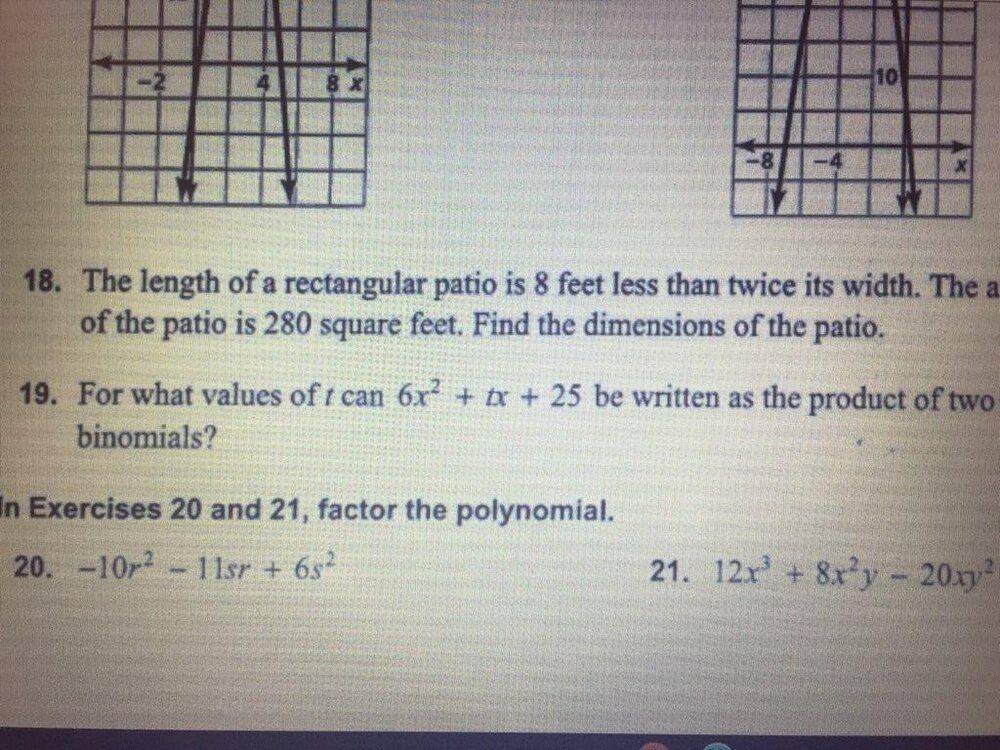
@Mark44 said, if ##b^2-4ac## is a perfect square, then ##ax^2+bx+c ## can be written as the product of two binomials. For your (granddaughter's) problem, you need ##t^2-600## to be a perfect square, (as well as being positive, of course).
This problem may be done this way, but it will be quite cumbersome. There are at least 6 possible values for t.
Another way to do this is to systematically find all of the pairs of binomials product give ##6x^2## for the leading term and ##25## for the constant term.
For example: ##(2x + ?)\times(3x + ?)## gives ##6x^2 + ... ##
and ##(?x + 1)\times(?x + 25)## gives ## ?x^2 +?x + 25##