How to solve using Leibniz Rule

  • Thread starter Thread starter Md. Abde Mannaf
  • Start date Start date
  • Tags Tags
    Leibniz
Click For Summary
SUMMARY

The discussion revolves around solving an integral using the Leibniz Rule, specifically the expression $$\frac{d}{dx} \int_{a(x)}^{b(x)} f(t) dt = f(b(x)) b'(x) - f(a(x)) a'(x)$$. Participants express confusion regarding the problem statement and suggest using variable substitutions, such as ##u = \tan(x/2)## and ##u = \cos(x)##, to simplify the integral. The conversation highlights the challenges of integrating functions like $$\int \frac{1}{1+\alpha \cos(x)} dx$$ and recommends using tools like Wolfram Alpha for assistance. The consensus is that while the Leibniz Rule is applicable, the integral remains complex and requires careful manipulation.

PREREQUISITES
  • Understanding of the Leibniz Rule for differentiation under the integral sign.
  • Familiarity with trigonometric identities and substitutions.
  • Knowledge of integral calculus, particularly with respect to improper integrals.
  • Experience using computational tools like Wolfram Alpha for solving integrals.
NEXT STEPS
  • Study the application of the Leibniz Rule in various contexts, particularly in integral calculus.
  • Learn about trigonometric substitutions, specifically the tangent half-angle substitution.
  • Explore the properties and techniques for evaluating improper integrals.
  • Practice solving integrals involving trigonometric functions and their transformations.
USEFUL FOR

Students of calculus, mathematicians, and anyone tackling complex integrals using the Leibniz Rule and trigonometric substitutions.

Md. Abde Mannaf
Messages
20
Reaction score
1

Homework Statement


Screenshot_2015_06_09_12_12_31.png


Homework Equations

The Attempt at a Solution
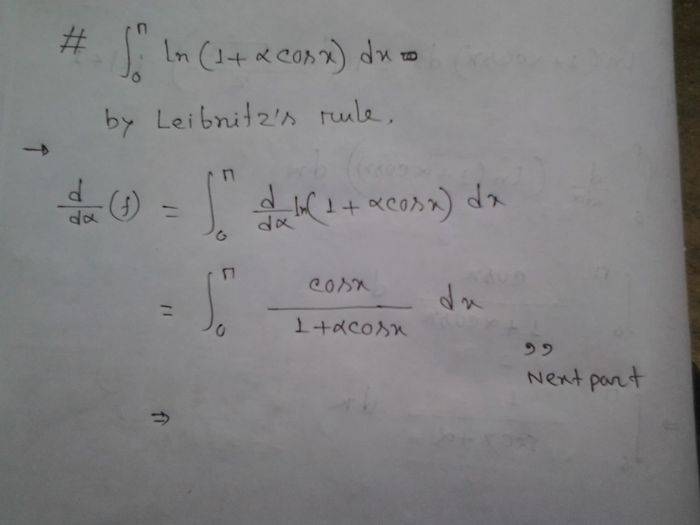

2015_06_10_07_15_35.jpg


here is i am still stuck.
 
  • Like
Likes   Reactions: berkeman
Physics news on Phys.org
I believe there are quite a few typos in the problem statement if you are intending to use Leibniz rule. I for one have never seen an ##\text{In}## function before.

The Leibniz rule in one dimension would be:

$$\frac{d}{dx} \int_{a(x)}^{b(x)} f(t) dt = f(b(x)) b'(x) - f(a(x)) a'(x)$$

EDIT: It would be more appropriate to call this the fundamental theorem.
 
Last edited:
  • Like
Likes   Reactions: Md. Abde Mannaf
at first i am use substitution. some one said
Don't use substitution, use Leibniz rule with α as the second variable.

what am i do now?
 
i know the Leibniz's rule. i solve many mathematical term . bt i cann't solve this math with Leibniz rule. i am still stuck
here. here limit is constant so 2nd and 3rd term will be zero.
 
any one solve this mathematical term and prove it??
 
Md. Abde Mannaf said:
i know the Leibniz's rule. i solve many mathematical term . bt i cann't solve this math with Leibniz rule. i am still stuck
here. here limit is constant so 2nd and 3rd term will be zero.

Your application of Leibnitz' rule is correct. You could try to change variables to ##u = \cos(x)## in your integral.
 
  • Like
Likes   Reactions: Md. Abde Mannaf
Zondrina said:
if you are intending to use Leibniz rule. I for one have never seen an In\text{In} function before.
See this, example 3.
Now let's do that daunting looking integral. Like I said before, this is a good problem.
First write ##\int_0^{\pi} \frac{1}{\alpha}-\frac{1}{(\alpha)(1+\alpha cos(x))} dx## for the original integral.
However ##\int \frac{1}{1+\alpha cos(x)} dx## itself is not nice, in-fact it's pretty nasty. It will be an interesting exercise to do, but even after that there is a good bit to do for the original problem. So I would recommend you use Wolfram for that for now, and proceed.
 
  • Like
Likes   Reactions: Md. Abde Mannaf
i could not solve this math above analysis . i am trying to my best. but i am fail every time. and again try...

please see this and give me more idea to solve

proxy.php?image=http%3A%2F%2Fs10.postimg.org%2F73jxqf5uh%2FScreenshot_2015_06_09_12_12_31.png


Screenshot_2015_06_10_15_36_42.png
 
  • #10
Md. Abde Mannaf said:

Homework Statement


Screenshot_2015_06_09_12_12_31.png


Homework Equations

The Attempt at a Solution


2015_06_10_07_15_35.jpg


here is i am still stuck.
You can even cheat :) using wolframalpha.com.
The substitution tan(x/2)=u works well if you have a rational expression of trigonometric functions. Try.
 
  • Like
Likes   Reactions: Md. Abde Mannaf
  • #11
Zondrina said:
I believe there are quite a few typos in the problem statement if you are intending to use Leibniz rule. I for one have never seen an ##\text{In}## function before.

The Leibniz rule in one dimension would be:

$$\frac{d}{dx} \int_{a(x)}^{b(x)} f(t) dt = f(b(x)) b'(x) - f(a(x)) a'(x)$$

EDIT: It would be more appropriate to call this the fundamental theorem.

The derivation of the OP is correct. Read Leibnitz Rule http://en.wikipedia.org/wiki/Leibniz_integral_rule
 
  • Like
Likes   Reactions: Md. Abde Mannaf
  • #12
In regards to post #9:- I'm not entirely sure what you're trying to do here. Did you have a look at the links I provided in post #8. I think your trying to come up with a value for ##\int_0^{\pi} \frac{1}{1+\alpha cos(x)} dx## for ##|\alpha|<1##using ##\int_0^{\pi} \frac{1}{\alpha-cos(x)} dx=\frac{\pi}{\sqrt{\alpha^2-1}}## for ##|\alpha|>1##, however that + sign in the original integral makes a good difference.
ehild said:
You can even cheat :) using wolframalpha.com.
Does no one read my posts :-)
 
  • Like
Likes   Reactions: Md. Abde Mannaf
  • #13
Md. Abde Mannaf said:
i could not solve this math above analysis . i am trying to my best. but i am fail every time. and again try...

please see this and give me more idea to solve
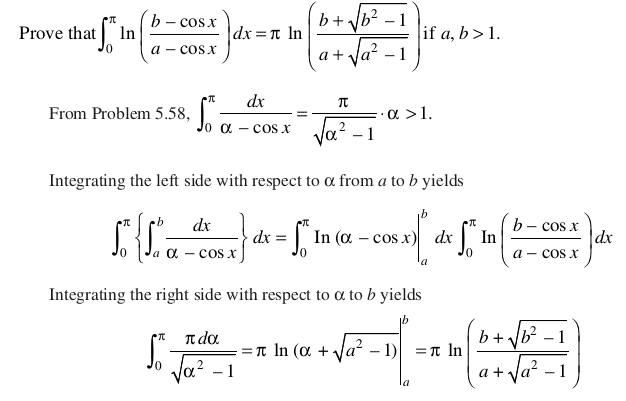
proxy.php?image=http%3A%2F%2Fs10.postimg.org%2F73jxqf5uh%2FScreenshot_2015_06_09_12_12_31.png


Screenshot_2015_06_10_15_36_42.png
You can write your integral for ##f'(\alpha)## as ##\int_0^{\pi/2} + \int_{\pi/2}^{\pi}##, then change variables to ##x \leftarrow \pi -x## in the second integral, to get
f&#039;(\alpha) = \int_0^{\pi/2} \left[ \frac{\cos(x)}{1 + \alpha \cos(x)} - \frac{\cos(x)}{1 - \alpha \cos(x)} \right] \, dx \\<br /> = -\int_0^{\pi/2} \frac{2 \alpha \cos^2(x)}{1 - \alpha^2 \cos^2(x)} \, dx
Changing variables to ##\tan(x) = y## produces an integral in ##y## that can be split up into partial fractions, giving two well-known and easily do-able integrations.
 
  • Like
Likes   Reactions: Md. Abde Mannaf
  • #14
certainly said:
Now let's do that daunting looking integral. Like I said before, this is a good problem.
First write ##\int_0^{\pi} \frac{1}{\alpha}-\frac{1}{(\alpha)(1+\alpha cos(x))} dx## for the original integral.
However ##\int \frac{1}{1+\alpha cos(x)} dx## itself is not nice, in-fact it's pretty nasty.
##\int \frac{1}{1+\alpha cos(x)} dx## is not that nasty.
Use the identity ##\cos(x)=\frac{1-\tan^2(x/2)}{1+\tan^2(x/2)}##. Substitute u=tan(x/2), x=2arctan(u), ##dx=\frac{2}{1+u^2}du##. The integration limits become 0-->infinite.
 
  • Like
Likes   Reactions: Md. Abde Mannaf and SammyS
  • #15
  • Like
Likes   Reactions: Md. Abde Mannaf
  • #16
ehild said:
##\int \frac{1}{1+\alpha cos(x)} dx## is not that nasty.
Use the identity ##\cos(x)=\frac{1-\tan^2(x/2)}{1+\tan^2(x/2)}##. Substitute u=tan(x/2), x=2arctan(u), ##dx=\frac{2}{1+u^2}du##. The integration limits become 0-->infinite.
Yeah, your right. I didn't actually do the integral, I only saw the answer and thought, this might take some time.
 
  • Like
Likes   Reactions: Md. Abde Mannaf

Similar threads

  • · Replies 4 ·
Replies
4
Views
2K
  • · Replies 0 ·
Replies
0
Views
1K
  • · Replies 12 ·
Replies
12
Views
3K
  • · Replies 13 ·
Replies
13
Views
1K
  • · Replies 7 ·
Replies
7
Views
4K
  • · Replies 1 ·
Replies
1
Views
2K
  • · Replies 2 ·
Replies
2
Views
2K
  • · Replies 23 ·
Replies
23
Views
2K
  • · Replies 28 ·
Replies
28
Views
6K
  • · Replies 4 ·
Replies
4
Views
2K
