How to solve vector addition problems for physics?

Click For Summary
To solve vector addition problems in physics, it's essential to understand that operations like A - B + C involve adding and subtracting vectors based on their components. The discussion highlights the importance of calculating vector components correctly and emphasizes that A - B + C means adding vector A to the negative of vector B and then adding vector C. A suggestion is made to visualize the vectors through drawing rather than solely relying on calculations. The forum encourages verifying calculations and understanding the underlying concepts of vector addition for clarity. Mastering these principles is crucial for successfully tackling vector problems in physics.
desi_chick
Messages
2
Reaction score
0
1. For the vectors given in Fig. 3-32 (|A| = 64.0 and θ = 51.0°), determine the following. Find the magnitude and direction for each of the following : 1) A-B+C 2) A+B-C 3) C-A-B.
heres a diagram with it:
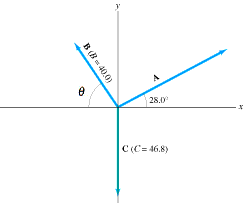
3_35alt.gif


2. The graph above should help, but I'm stuck on what to do


3. I basically set A= D1, B= D2 and C=D3. i found each vector component value: D1X=56.5, D1Y= 55.43 and so on for D2 and D3. i think I'm completely wrong since i don't understand what the question is asking for. i have a physics final on monday and I'm really lost!
 
Physics news on Phys.org
If you add three vectors, the result will be a vector. The question is asking you to find the magnitude and direction of this resultant vector (the sum) in three different cases (for three different ways of combining the three vectors).

I do not see how setting A = D1, B = D2, and C = D3 helps you in any way (other than changing the names of the vectors you are adding together).

Although you are right that adding the three vectors together component-wise is a good strategy, your x and y components of A do not look right. I would double check the calculations.

EDIT: Bear in mind that we can't see your attached picture yet. It takes time for the forum to approve the attachment.

EDIT: And by the way, welcome to PF!
 
oh I'm still pretty lost, like i just want to know what A-B+C means for example.
 
It's vector addition. A - B + C literally means vector A added to the negative of vector B added to vector C. If you have been taught in class how to add vectors (and you must have been), and you have been taught what the negative of a vector means, then you should be able to do the problem.

Now that I see the picture, I see that it might be easier to do the vector addition just by drawing a picture, rather than by calculating x and y components.
 
The book claims the answer is that all the magnitudes are the same because "the gravitational force on the penguin is the same". I'm having trouble understanding this. I thought the buoyant force was equal to the weight of the fluid displaced. Weight depends on mass which depends on density. Therefore, due to the differing densities the buoyant force will be different in each case? Is this incorrect?

Similar threads

Replies
11
Views
3K
Replies
1
Views
3K
Replies
8
Views
2K
  • · Replies 4 ·
Replies
4
Views
2K
Replies
4
Views
2K
Replies
2
Views
2K
Replies
5
Views
3K
Replies
5
Views
2K
  • · Replies 2 ·
Replies
2
Views
4K
  • · Replies 12 ·
Replies
12
Views
2K