How to solve vector addition problems for physics?

Click For Summary

Homework Help Overview

The discussion revolves around vector addition problems in physics, specifically focusing on determining the magnitude and direction of resultant vectors from given vectors A, B, and C. The original poster expresses confusion regarding the problem's requirements and the calculations involved.

Discussion Character

  • Exploratory, Conceptual clarification, Mathematical reasoning

Approaches and Questions Raised

  • Participants discuss the method of vector addition, including component-wise addition and the implications of negative vectors. The original poster questions the meaning of expressions like A-B+C and expresses uncertainty about their calculations.

Discussion Status

Some participants provide guidance on the nature of vector addition and suggest that visual representation may aid understanding. There is an acknowledgment of the original poster's confusion, and attempts to clarify the process are ongoing.

Contextual Notes

The original poster mentions a looming physics final, indicating a time constraint and a sense of urgency in understanding the material. There is also a note about an attached diagram that has not yet been approved for viewing by the forum.

desi_chick
Messages
2
Reaction score
0
1. For the vectors given in Fig. 3-32 (|A| = 64.0 and θ = 51.0°), determine the following. Find the magnitude and direction for each of the following : 1) A-B+C 2) A+B-C 3) C-A-B.
heres a diagram with it:
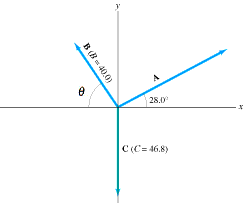
3_35alt.gif


2. The graph above should help, but I'm stuck on what to do


3. I basically set A= D1, B= D2 and C=D3. i found each vector component value: D1X=56.5, D1Y= 55.43 and so on for D2 and D3. i think I'm completely wrong since i don't understand what the question is asking for. i have a physics final on monday and I'm really lost!
 
Physics news on Phys.org
If you add three vectors, the result will be a vector. The question is asking you to find the magnitude and direction of this resultant vector (the sum) in three different cases (for three different ways of combining the three vectors).

I do not see how setting A = D1, B = D2, and C = D3 helps you in any way (other than changing the names of the vectors you are adding together).

Although you are right that adding the three vectors together component-wise is a good strategy, your x and y components of A do not look right. I would double check the calculations.

EDIT: Bear in mind that we can't see your attached picture yet. It takes time for the forum to approve the attachment.

EDIT: And by the way, welcome to PF!
 
oh I'm still pretty lost, like i just want to know what A-B+C means for example.
 
It's vector addition. A - B + C literally means vector A added to the negative of vector B added to vector C. If you have been taught in class how to add vectors (and you must have been), and you have been taught what the negative of a vector means, then you should be able to do the problem.

Now that I see the picture, I see that it might be easier to do the vector addition just by drawing a picture, rather than by calculating x and y components.
 

Similar threads

Replies
11
Views
3K
Replies
1
Views
3K
Replies
8
Views
2K
Replies
4
Views
2K
  • · Replies 4 ·
Replies
4
Views
2K
Replies
2
Views
2K
Replies
5
Views
3K
Replies
5
Views
2K
  • · Replies 2 ·
Replies
2
Views
4K
  • · Replies 12 ·
Replies
12
Views
2K