Undergrad How to understand the Bloch sphere in the quantum computation?

Click For Summary
SUMMARY

The discussion focuses on understanding the Bloch sphere representation in quantum computation, specifically how the states ##\left | 0 \right >## and ##\left | 1 \right >## are represented as orthonormal vectors. It clarifies that while these states are orthogonal, their representation on the Bloch sphere can appear parallel due to the geometric interpretation of quantum states. The conversation also touches on the eigenvalues of a spin-1/2 particle and how they relate to the Bloch sphere's axes, emphasizing the transformation of states like ##|\pm x \rangle## and ##|\pm y \rangle##. Additionally, it notes that spin half particles require 720 degrees to return to their original state.

PREREQUISITES
  • Understanding of quantum states and notation, specifically ##\left | 0 \right >## and ##\left | 1 \right >##.
  • Familiarity with the Bloch sphere representation in quantum mechanics.
  • Knowledge of spin-1/2 particles and their eigenvalues.
  • Basic grasp of complex numbers and their role in quantum state representation.
NEXT STEPS
  • Study the mathematical representation of quantum states using the Bloch sphere.
  • Learn about the transformation of quantum states between different bases, such as ##|\pm x \rangle## and ##|\pm y \rangle##.
  • Explore the implications of spin-1/2 particles and their behavior under rotations.
  • Investigate the significance of the 720-degree rotation in quantum mechanics.
USEFUL FOR

This discussion is beneficial for quantum computing enthusiasts, physicists, and students studying quantum mechanics, particularly those interested in the geometric interpretation of quantum states and the Bloch sphere.

Haorong Wu
Messages
419
Reaction score
90
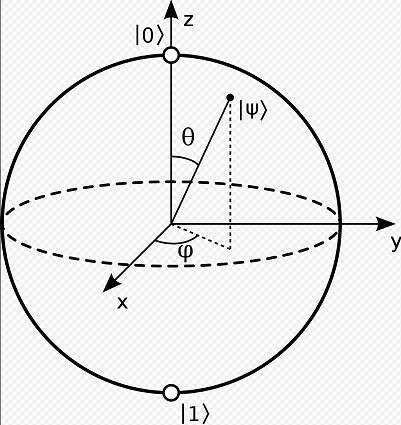
I've read that ##\left | \psi \right > =cos \frac \theta 2 \left | 0 \right > + e^{i \phi} sin \frac \theta 2 \left | 1 \right >##, and the corresponding point in the Bloch sphere is as the fig below shows.
无标题.jpg


I think ##\left | 0 \right >## and ##\left | 1 \right >## are orthonormal vectors, then why they seem to apear parallel in the Bloch sphere?

Also, I can understand the ##cos \frac \theta 2 \left | 0 \right >## part, but I cannot understand how ##e^{i \phi} sin \frac \theta 2 \left | 1 \right >## part can match the fig.

Thanks!
 
Physics news on Phys.org
Consider a spin-1/2 particle. The two eigenvalues of ##S_z## are ##\pm \hbar/2##, which correspond to opposite points along ##z##. The fact that ##|+z\rangle## and ##|-z\rangle## are orthogonal states must not be confused with the orthogonality of the cartesian axes.

Likewise, consider that
$$
|\pm x \rangle = \frac{1}{\sqrt{2}} \left( |+z \rangle \pm |-z \rangle \right) \\
|\pm y \rangle = \frac{1}{\sqrt{2}} \left( |+z \rangle \pm i |-z \rangle \right)
$$
This is exactly what is transposed to the Bloch sphere.
 
Haorong Wu said:
I think ##\left | 0 \right >## and ##\left | 1 \right >## are orthonormal vectors, then why they seem to apear parallel in the Bloch sphere?

Spin half particles take 720 degrees to return to their original state.

Cheers
 
Time reversal invariant Hamiltonians must satisfy ##[H,\Theta]=0## where ##\Theta## is time reversal operator. However, in some texts (for example see Many-body Quantum Theory in Condensed Matter Physics an introduction, HENRIK BRUUS and KARSTEN FLENSBERG, Corrected version: 14 January 2016, section 7.1.4) the time reversal invariant condition is introduced as ##H=H^*##. How these two conditions are identical?

Similar threads

  • · Replies 1 ·
Replies
1
Views
2K
  • · Replies 15 ·
Replies
15
Views
821
  • · Replies 7 ·
Replies
7
Views
2K
  • · Replies 5 ·
Replies
5
Views
2K
  • · Replies 4 ·
Replies
4
Views
3K
  • · Replies 2 ·
Replies
2
Views
1K
  • · Replies 4 ·
Replies
4
Views
1K
  • · Replies 2 ·
Replies
2
Views
2K
  • · Replies 4 ·
Replies
4
Views
2K
  • · Replies 2 ·
Replies
2
Views
2K