How were differential equations for SIR Models calculated?

Click For Summary
SUMMARY

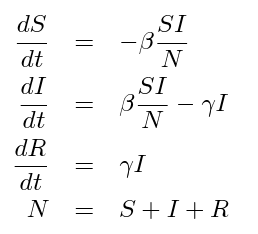
The discussion centers on the calculation of differential equations for SIR (Susceptible, Infected, Recovered) models, emphasizing their reliance on parameters such as β (transmission rate), γ (recovery rate), and initial conditions. The validity of these models is determined through empirical data comparisons rather than formal mathematical proofs. Key references include the original paper by Reed and Frost and relevant Wikipedia entries that provide foundational knowledge and context for understanding these models in infectious disease modeling.

PREREQUISITES
  • Understanding of SIR models in epidemiology
  • Familiarity with differential equations
  • Knowledge of parameters β and γ in infectious disease modeling
  • Ability to interpret empirical data in the context of mathematical models
NEXT STEPS
  • Research the original paper by Reed and Frost on SIR models
  • Explore the mathematical modeling of infectious diseases through the Wikipedia entry
  • Analyze empirical data from the SARS outbreak (2002/2003) for model validation
  • Study the implications of varying initial conditions in SIR model outcomes
USEFUL FOR

Researchers, epidemiologists, and students interested in mathematical modeling of infectious diseases, particularly those focusing on SIR models and their applications in real-world scenarios.

Sam Donovan
Messages
11
Reaction score
0
Member advised to do some research before posting
Specifically:
sireqn.png
 
Physics news on Phys.org
What do you mean by proof?
These models are a method to describe what actually happens. It can only be said to which extend their solutions are proper descriptions of reality or not, i.e. whether a certain choice of parameters and initial conditions lead to such a valid description or not. So a "proof" can only be a comparison with empiric data. SIR models are a class of models, depending on the choice of ##\beta, \gamma## and eventually ##N## plus initial conditions like ##\left. \frac{dS}{dt}\right|_{t=0} =S_0##. I would look for the original paper of Reed and Frost or the links on the Wiki page. Also the SARS outbreak in 2002/2003 could provide several data for comparisons.
 

Similar threads

  • · Replies 2 ·
Replies
2
Views
1K
  • · Replies 4 ·
Replies
4
Views
2K
  • · Replies 2 ·
Replies
2
Views
2K
  • · Replies 3 ·
Replies
3
Views
1K
Replies
5
Views
4K
  • · Replies 3 ·
Replies
3
Views
5K
  • · Replies 3 ·
Replies
3
Views
2K
  • · Replies 7 ·
Replies
7
Views
4K
  • · Replies 3 ·
Replies
3
Views
2K
  • · Replies 7 ·
Replies
7
Views
2K