Hydraulic piston force as a function of angle for a launcher

Click For Summary

Discussion Overview

The discussion revolves around determining the force experienced by a hydraulic piston in a missile launcher as a function of the launcher's angle. Participants explore the application of kinematics and the principle of Virtual Work to derive a relationship between the piston force and the angle, while also addressing the complexities introduced by changing angles and force directions.

Discussion Character

  • Technical explanation
  • Mathematical reasoning
  • Homework-related

Main Points Raised

  • One participant notes the necessity of specifying dimensions, such as the distance between pivots, to approach the problem effectively.
  • Another suggests starting with a generalized coordinate, specifically the length of the hydraulic system, to apply the principle of Virtual Work.
  • A participant expresses difficulty in applying Virtual Work due to the changing direction of force and angle of the beam, requesting a parametric solution.
  • One participant provides equations relating the lengths and angles involved in the system, suggesting a method to express one angle as a function of the hydraulic unit length.
  • Discussion includes the need to relate the center of mass height to the generalized coordinate as part of the kinematics involved.

Areas of Agreement / Disagreement

Participants generally agree on the need for kinematic analysis and the application of Virtual Work, but there is no consensus on how to proceed with the solution, particularly regarding the complexity introduced by changing angles and forces.

Contextual Notes

Participants highlight the importance of specific parameters and dimensions, as well as the challenges posed by the dynamic nature of the forces and angles involved in the problem. There are unresolved mathematical steps related to the application of Virtual Work.

ker mod
Messages
4
Reaction score
0
Hello,

A friend of mine challenged me with a question related to erection of missile launcher. For some reason and after too long struggling with it i gave up and trying now to figure out what is the point that I'm missing. The task is to fine the force that the piston is "feeling" as function of the angle of the launcher. I have attached a picture. Can someone provide me an elaborated solution?

In addition, i would like to have a graph of this relation between force and angle?
I got lost with the trigonometry...
Keril
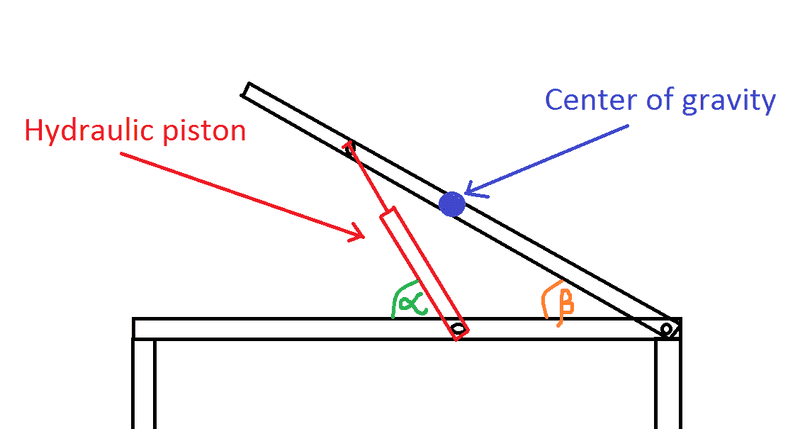
Untitled.png
 
Engineering news on Phys.org
You need to specify the dimensions (distance between pivots, etc) before this can be attacked. With that information given, then there is a bit of kinematics required and the application of the principle of Virtual Work will lead directly to the desired result.
 
I see. So i have added parameters. how can virtual work be done?
Untitled.png
 
To apply the principal of Virtual Work, you need to begin with a generalized coordinate (I'd use the length of the hydraulic system). Then calculate the virtual work done due to a change in the generalized coordinate. In order to do this, you will first need to relate the height of the CM to the generalized coordinate, a kinematics problem.
 
where can i find a similar problem with a virtual work solution?
 
There is a somewhat similar problem solved by virtual work in Mechanics of Machines by Doughty (Wiley, 1988), p. 223. This is part of a chapter on Statics by Virtual Work.
 
thank you for that information. unfortunately. i do not have an access to the library anymore. can you try to solve this problem parametriclly? I find this problem kind of complicated because the force direction is changing all the time and the beam angle is changing as well... I'm trying to use virtual work, and need to take the virtual motion multiplied by the displacement on the same direction...it is changing all the time :))
 
The key to this problem, and so many others, is int the kinematics. Let's talk about that first.

Let q denote the length of the hydraulic unit. Then the following equations are true from the triangle:
B + q*cos(alpha) = L2*cos(beta)
q*sin(alpha) = L2*sin(beta)
Can you solve this system to express beta = f(q)?

Assuming that you can then you can write
Ycm = L1*sin(beta)
V = W*Ycm - potential energy
F * delta q - delta V = 0 - virtual work done on the system
Form the necessary variations and solve for F, the piston force.
 
  • Like
Likes   Reactions: Avichal Tiwari

Similar threads

  • · Replies 1 ·
Replies
1
Views
2K
  • · Replies 8 ·
Replies
8
Views
2K
  • · Replies 4 ·
Replies
4
Views
1K
  • · Replies 8 ·
Replies
8
Views
9K
  • · Replies 2 ·
Replies
2
Views
4K
  • · Replies 11 ·
Replies
11
Views
2K
  • · Replies 14 ·
Replies
14
Views
3K
Replies
2
Views
1K
  • · Replies 3 ·
Replies
3
Views
2K
Replies
12
Views
5K