mcastillo356
Gold Member
- 666
- 365
- TL;DR
- I look at the limit, and I look at the definition, and I don't match both concepts, though I should.
Hi, PF, I hope the doubts are going to be vanished in a short while:
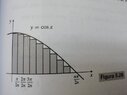
This is the limit of Riemann Sum
##\displaystyle\lim_{n\rightarrow{\infty}}\displaystyle\frac{1}{n}\displaystyle\sum_{j=1}^{n}\cos\Big(\displaystyle\frac{j\pi}{2n}\Big)##
And this is the definition of the limit of the General Riemann Sum:
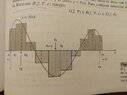
Let ##P=\{x_0,x_1,x_2,...,x_n\}## where ##a=x_0<x_1<x_2<\cdots{<x_n=b}##, be a partition of ##[a,b]## having norm ##||P||=\mbox{max}_{1\leq i\leq\n}\,Deltax_i##. In each subinterval of ##P## pick a point ##c_i## (called a tag). Let ##c=(c_1,c_2,...,c_n)## denote the set of these tags. The sum ##R(f,P,c)=\displaystyle\sum_{i=1}^n\,f(c_i)\Delta{x_i}=f(c_1)\Delta{x_1}+f(c_2)\Delta{x_2}+f(c_3)\Delta{x_3}+\cdot{f(c_n)\Delta{x_n}}## is called the Riemann sum of ##[a,b]## corresponding to partition ##P## and tags ##c##.
Doubts: On the expression ##\displaystyle\lim_{n\rightarrow{\infty}}\displaystyle\frac{1}{n}\displaystyle\sum_{j=1}^{n}\cos\Big(\displaystyle\frac{j\pi}{2n}\Big)##, how must I manage to bridge the gap?
This is the limit of Riemann Sum
##\displaystyle\lim_{n\rightarrow{\infty}}\displaystyle\frac{1}{n}\displaystyle\sum_{j=1}^{n}\cos\Big(\displaystyle\frac{j\pi}{2n}\Big)##
And this is the definition of the limit of the General Riemann Sum:
Let ##P=\{x_0,x_1,x_2,...,x_n\}## where ##a=x_0<x_1<x_2<\cdots{<x_n=b}##, be a partition of ##[a,b]## having norm ##||P||=\mbox{max}_{1\leq i\leq\n}\,Deltax_i##. In each subinterval of ##P## pick a point ##c_i## (called a tag). Let ##c=(c_1,c_2,...,c_n)## denote the set of these tags. The sum ##R(f,P,c)=\displaystyle\sum_{i=1}^n\,f(c_i)\Delta{x_i}=f(c_1)\Delta{x_1}+f(c_2)\Delta{x_2}+f(c_3)\Delta{x_3}+\cdot{f(c_n)\Delta{x_n}}## is called the Riemann sum of ##[a,b]## corresponding to partition ##P## and tags ##c##.
Doubts: On the expression ##\displaystyle\lim_{n\rightarrow{\infty}}\displaystyle\frac{1}{n}\displaystyle\sum_{j=1}^{n}\cos\Big(\displaystyle\frac{j\pi}{2n}\Big)##, how must I manage to bridge the gap?