I don't understand this step in turning this negative into a positive

Click For Summary
SUMMARY

The discussion centers on the simplification of the expression -2/(b-a) to 2/(a-b). Participants clarify that this transformation occurs by multiplying both the numerator and denominator by -1, which does not change the value of the fraction. This technique is commonly used to convert negative fractions into positive ones for clarity. The final consensus is that expressing fractions with positive numerators is generally preferred for neatness and ease of understanding.

PREREQUISITES
  • Understanding of basic algebraic manipulation
  • Familiarity with fractions and their properties
  • Knowledge of negative numbers and their operations
  • Ability to interpret mathematical expressions and equations
NEXT STEPS
  • Study the properties of fractions, including simplification techniques
  • Learn about algebraic expressions and their manipulation
  • Explore the concept of multiplying fractions by -1 for simplification
  • Practice solving similar algebraic problems to reinforce understanding
USEFUL FOR

Students learning algebra, educators teaching mathematical concepts, and anyone seeking to improve their skills in fraction manipulation and algebraic simplification.

Nathi ORea
Messages
82
Reaction score
22
Homework Statement
I don't understand the final step of this working out
Relevant Equations
I don't think there is any.
So I have this question.
I get all the working out, but then I feel like the answer should be;
-2/(b-a).
Then I thought -2/(-a+b) must just be the same thing... all good so far..
Then they somehow just to 2/(a-b) as the final answer.. I'm lost there. How does that conversion happen?
Appreciate any help.
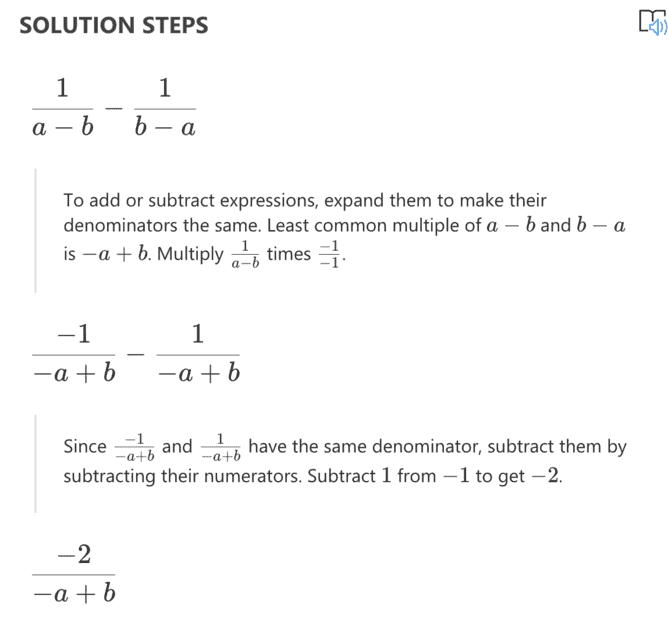
Screen Shot 2023-03-07 at 5.08.52 pm.png
 
Physics news on Phys.org
Nathi ORea said:
Then they somehow just to 2/(a-b) as the final answer.. I'm lost there. How does that conversion happen?
I believe they just multiplied by ##\frac{-1}{-1}## to get rid of the negative on top. Since ##\frac{-1}{-1}## is equal to ##1## you aren't changing the value of the fraction when you do so.
 
Nathi ORea said:
Homework Statement:: I don't understand the final step of this working out
Relevant Equations:: I don't think there is any.

So I have this question.
I get all the working out, but then I feel like the answer should be;
-2/(b-a).
Then I thought -2/(-a+b) must just be the same thing... all good so far..
Then they somehow just to 2/(a-b) as the final answer.. I'm lost there. How does that conversion happen?
Appreciate any help.View attachment 323312
That's a somewhat odd approach, IMO. I would have done:
$$\frac{1}{a-b} - \frac 1 {b-a} = \frac 1 {a -b} + \frac 1 {a -b} = \frac 2 {a-b}$$
 
  • Like
Likes   Reactions: berkeman and topsquark
In the original solution, note that:
$$\frac{-X}{-Y} = \frac X Y$$For any expressions ##X## and ##Y##.
 
  • Like
Likes   Reactions: Nathi ORea and topsquark
Drakkith said:
I believe they just multiplied by ##\frac{-1}{-1}## to get rid of the negative on top. Since ##\frac{-1}{-1}## is equal to ##1## you aren't changing the value of the fraction when you do so.
Ok.. that’s what they did aye

Is there a reason why they did that?
 
Nathi ORea said:
Ok.. that’s what they did aye

Is there a reason why they did that?
Is it just neater to have a positive as the numerator or something?
 
Nathi ORea said:
Is it just neater to have a positive as the numerator or something?
It's because both the numerator and denominator were negative. It's much neater and easier to turn such fractions into positives. I'm sure you'd agree that ##\frac{-1}{-3}## is better to write as ##\frac{1}{3}## instead.
 

Similar threads

Replies
6
Views
3K
Replies
11
Views
2K
  • · Replies 4 ·
Replies
4
Views
2K
Replies
19
Views
3K
  • · Replies 18 ·
Replies
18
Views
3K
Replies
5
Views
2K
Replies
13
Views
5K
  • · Replies 5 ·
Replies
5
Views
2K
Replies
1
Views
2K
  • · Replies 10 ·
Replies
10
Views
2K