I just wanted to know how to find error/uncertainties from the graph

  • Thread starter Thread starter vpt069
  • Start date Start date
  • Tags Tags
    Graph
Click For Summary
SUMMARY

This discussion focuses on estimating uncertainties for unmeasured data points in a graph representing surface tension at varying concentrations (ppm). The user seeks to predict the uncertainty at 175 ppm, where no direct measurement exists. Key insights include the necessity of having measured data to assign uncertainty and the potential use of trendlines and statistical methods, such as spline fitting, to estimate values. The conversation emphasizes the importance of understanding the measurement process and the limitations of interpolating values without a theoretical model.

PREREQUISITES
  • Understanding of surface tension measurements and their significance.
  • Familiarity with statistical methods, particularly standard deviation and error analysis.
  • Knowledge of trendline fitting techniques, including spline fitting.
  • Basic concepts of data interpolation and extrapolation in scientific measurements.
NEXT STEPS
  • Research "spline fitting techniques" for estimating unmeasured data points.
  • Study "error propagation methods" to understand how uncertainties affect predictions.
  • Explore "standard deviation calculations" for assessing measurement reliability.
  • Investigate "interpolation vs. extrapolation" to differentiate between estimating within and outside measured ranges.
USEFUL FOR

Researchers, data analysts, and scientists involved in experimental measurements, particularly those working with surface tension and concentration data, will benefit from this discussion.

vpt069
Messages
12
Reaction score
0
Homework Statement
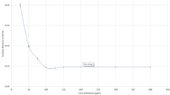
I just wanted to know how to find errors/uncertainties from the graph. You can see the graph, I want to find the uncertainties at 175 ppm where I have not measured at 175 ppm. so, if I want to know the error for the particular value. what predication/equation should I use?
Relevant Equations
I do not have any idea.
Untitled.png
 
Physics news on Phys.org
Hello @vpt069 ,
:welcome:
The information available is not sufficient to conclude an uncertainty. You will have to make a separate consideration to estimate that, I'm afraid.

## \ ##
 
BvU said:
Hello @vpt069 ,
:welcome:
The information available is not sufficient to conclude an uncertainty. You will have to make a separate consideration to estimate that, I'm afraid.

## \ ##
Hello expert,

I understand what you are trying to say. Let me explain.

So, In this graph, I have taken my measurements at different concentrations. So, I have taken at 25 ppm to 400 ppm. I have the value and the error/uncertainty for the exact concentration (i.e. 25,50,75,100,125,150,200,300,400 ppm) but suppose I want to find/predict the uncertainty of the point (i.e. 175 ppm) where I have not measured. So, Is there any equation should I use to find the error?
 
What exactly is the plot a graph of? You didn't label the axes, so it's not clear.
 
The short answer is "it depends" How did you assign the error bars on the graph?
 
If you have no measured point, you have no uncertainty on the measurement.
 
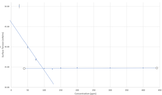
I have attached the graphs here for the same data. I can use the data both ways using tread lines.
 

Attachments

  • Untitled.png
    Untitled.png
    7.1 KB · Views: 108
  • Untitled.png
    Untitled.png
    6.5 KB · Views: 116
So now, can I find the uncertainties or errors of where two straight lines (trendlines) touch (around 90 ppm)?

Thank you.
 
Vanadium 50 said:
If you have no measured point, you have no uncertainty on the measurement.
Can't I predict from the other measured points?
 
  • #10
If the data is all from one apparatus on a particular run, and the data is gathered similarly, one could estimate the projected error using the observed error of nearby points. But this would need to be annotated carefully. As I said "it depends" and you need to understand the process.
 
  • #11
hutchphd said:
The short answer is "it depends" How did you assign the error bars on the graph?
 
  • #12
vpt069 said:
Concentration (ppm)Surface Tension (mN/m)Errors/Uncertainties (mN/m)
25​
50.06​
0.45​
50​
39.86​
0.22​
75​
36.83​
0.17​
100​
34.63​
0.03​
125​
34.49​
0.03​
150​
34.76​
0.02​
200​
34.81​
0.02​
300​
34.77​
0.03​
400​
34.76​
0.02​
Here I attached the measurements and errors for the measured values but I have not measured at the 175 ppm. so, how one may find errors for the unmeasured point?
 
  • #13
How is the last column obtained??
And why do you wish to generate more "data" ?
 
  • #14
hutchphd said:
How is the last column obtained??
And why do you wish to generate more "data" ?
So, the last column (error) obtained from the instrument (it is automatically calculated by the standard deviation of 60 measurements)

I want to find out/predict the exact point where the value becomes stable or consistent (by observing a horizontal straight line.
 
  • #15
What is the fitted curve in the graph? Is there an expected shape?
 
  • #16
Vanadium 50 said:
If you have no measured point, you have no uncertainty on the measurement.

hutchphd said:
What is the fitted curve in the graph? Is there an expected shape?
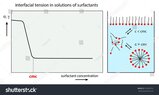
I do not see any pattern here but usually, in an interfacial tension graph, it starts with decreasing and then remains stable.
 
  • #17
hutchphd said:
What is the fitted curve in the graph? Is there an expected shape?
You can refer to this image.
 

Attachments

  • photo-slug-355205741.jpg
    photo-slug-355205741.jpg
    33.5 KB · Views: 111
  • #18
vpt069 said:
So, the last column (error) obtained from the instrument (it is automatically calculated by the standard deviation of 60 measurements)

I want to find out/predict the exact point where the value becomes stable or consistent (by observing a horizontal straight line.
In the absence of a theoretical model for how the transition occurs, it is not possible to interpolate a value. Judging from the image in post #17, a theoretical model should be feasible, but it might be quite complicated, involving the statistics of energy distribution.
That said, spline fitting is commonly used in engineering. Years ago I saw a paper that made a good case for gluing together arcsin(x) curves, but I forget the details. This paper uses "biarcs": https://core.ac.uk/download/pdf/81993903.pdf.
 
Last edited:
  • #19
vpt069 said:
I do not see any pattern here but usually, in an interfacial tension graph, it starts with decreasing and then remains stable.

vpt069 said:
So, the last column (error) obtained from the instrument (it is automatically calculated by the standard deviation of 60 measurements)

The occurrence of a significant dip at 125 ppm worries me no end. Is it a genuine theoretical possibility or an artefact ?

What is the time history of the measurements ? Are the individual measurements really independent (do you prepare fresh solutions in a new container from scratch for each new point?), or can there be some time lag ? If the measurement series are in sequence from low to high ppm, can there be an undershoot after the steep decline from 75 to 100 ?
Idem the overshoot at 200 ?

Is it possible to check the 60 measurements of individual points to see if they are really normally distributed in time, or possibly show some systematic drift ?

For 60 points (normally distributed) the standard deviation estimate has some 12% accuracy. It is strange that the last six points have 0.02 or 0.03 . Instrumental limit to two decimal places ?

Would going backwards from 425 to 0 (or 25) ppm produce the exact same result ?

Why the specific interest in the 175 ppm point ?

Lots of considerations possible. A real experimentational challenge :smile:

Without further detailed information it is impossible to distinguish between 34.80, 34.78 or 34.76, all ##\pm##0.02 , for 175 ppm

1635246893056.png


##\ ##
 
  • #20
Yes. I would say yes, all the questions you asked have been checked by us already. We have checked low ppm to high ppm, all 60 measurements have the same interval. 175 ppm is just for reference that I used here for how to find uncertainty for the unmeasured point. Is there any way I can use all the uncertainties of measured values/points to come up with error of unmeasured value?
 
  • #21
vpt069 said:
Yes. I would say yes, all the questions you asked have been checked by us already. We have checked low ppm to high ppm, all 60 measurements have the same interval. 175 ppm is just for reference that I used here for how to find uncertainty for the unmeasured point. Is there any way I can use all the uncertainties of measured values/points to come up with error of unmeasured value?
BvU said:
The occurrence of a significant dip at 125 ppm worries me no end. Is it a genuine theoretical possibility or an artefact ?

What is the time history of the measurements ? Are the individual measurements really independent (do you prepare fresh solutions in a new container from scratch for each new point?), or can there be some time lag ? If the measurement series are in sequence from low to high ppm, can there be an undershoot after the steep decline from 75 to 100 ?
Idem the overshoot at 200 ?

Is it possible to check the 60 measurements of individual points to see if they are really normally distributed in time, or possibly show some systematic drift ?

For 60 points (normally distributed) the standard deviation estimate has some 12% accuracy. It is strange that the last six points have 0.02 or 0.03 . Instrumental limit to two decimal places ?

Would going backwards from 425 to 0 (or 25) ppm produce the exact same result ?

Why the specific interest in the 175 ppm point ?

Lots of considerations possible. A real experimentational challenge :smile:

Without further detailed information it is impossible to distinguish between 34.80, 34.78 or 34.76, all ##\pm##0.02 , for 175 ppm

View attachment 291189

##\ ##
So, yes, and Instrument limit to two decimal points as well as once we reach the cmc (here, 125 ppm), errors were expected that low.
 

Similar threads

  • · Replies 10 ·
Replies
10
Views
949
  • · Replies 3 ·
Replies
3
Views
1K
  • · Replies 2 ·
Replies
2
Views
859
Replies
4
Views
805
Replies
15
Views
2K
Replies
15
Views
1K
  • · Replies 16 ·
Replies
16
Views
6K
  • · Replies 20 ·
Replies
20
Views
4K
  • · Replies 10 ·
Replies
10
Views
2K
  • · Replies 6 ·
Replies
6
Views
2K