I need a Straight Compact Linear data model

Click For Summary
SUMMARY

The discussion centers on identifying a Straight Compact Linear data model, with the user expressing dissatisfaction with the Pearson Correlation Coefficient (PCC) for this purpose. They reference Anscombe's quartet to illustrate the importance of visual data analysis. The user proposes a two-part solution involving calculating an average Standard Deviation through iteration and performing a Quadratic Regression to assess data straightness via Latus Rectum. The main challenge identified is the relative scale of data affecting the perception of compactness.

PREREQUISITES
  • Understanding of Pearson Correlation Coefficient (PCC)
  • Familiarity with Anscombe's quartet
  • Knowledge of Standard Deviation calculation
  • Experience with Quadratic Regression analysis
NEXT STEPS
  • Research methods for calculating Standard Deviation in datasets
  • Learn about Quadratic Regression and its applications
  • Explore data visualization techniques to assess linearity
  • Investigate alternative correlation metrics beyond Pearson's
USEFUL FOR

Data analysts, statisticians, and researchers looking to improve their understanding of linear data modeling and correlation analysis.

1plus1is10
Messages
51
Reaction score
0
Does anyone know a model to identify Straight Compact Linear data?

I've been toying with Pearson Correlation Coefficient and am very disappointed.
https://en.wikipedia.org/wiki/Pearson_correlation_coefficient
I originally thought that this would be exactly what I needed, but...
After some Googling, I soon discovered Anscombe's quartet.
https://en.wikipedia.org/wiki/Anscombe's_quartet

Frank Anscombe basically said "look at your data". Duh.
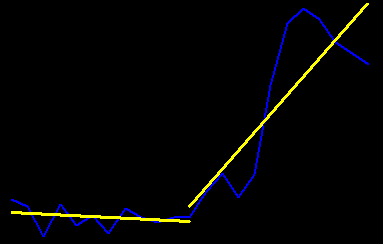
graph.png


Per online calculator: https://www.socscistatistics.com/tests/pearson/Default2.aspx
The first line's PCC is: -0.2679=bad. The X values are 1-12 and the Y values are:
53
46
19
48
29
38
22
44
36
32
36
36

The second line's PCC is: 0.8358=good. The Y values are:
36
60
76
54
75
156
212
226
216
195
185
175

I need a model where the first line is good and the second is bad.
Any ideas?
 

Attachments

  • graph.png
    graph.png
    1.3 KB · Views: 440
Physics news on Phys.org
PS... Straight can be up or down also, not just flat. As long as it is compact and straight.
 
After toying with this some more and also stopping to ask, "what do I actually see", I think I now understand the problem:
= It's all relative (it's all about scale).

Basically, if I look at each side of my graph independently, then the PCC results make much more sense.
More specifically, the top and bottom of the graph for the first line's data changes and the data no longer looks compact.
This is due to scale - it's no longer relative to the second line's data.

So, having realized the problem, I thought some more and stared at it some more, and I think I have a solution (for me anyway).
My solution actually has 2 parts:
1) Iterate through the entire data with a fixed/desired sample size to get an average Standard Deviation. Then use it as a comparison.
2) Do a Quadratic Regression of the desired data to calculate it's Latus Rectum and divide it by the sample size. The bigger the percent, the straighter the data.

If anyone can think of a better hammer, I'd still like to hear from you.
(my eyes see that there has to be something regarding crossovers, but I got nothing yet)
Thanks