Ice worlds' inner oceans--Emily Lakdawalla

  • Context: Graduate 
  • Thread starter Thread starter marcus
  • Start date Start date
  • Tags Tags
    Ice
Click For Summary

Discussion Overview

The discussion revolves around the characteristics of inner oceans on icy celestial bodies, particularly focusing on Ganymede and Ceres. Participants explore how scientists infer the presence of ice layers and potential subsurface oceans, including factors like salinity, tidal heating, and the differentiation of materials within these bodies.

Discussion Character

  • Exploratory
  • Technical explanation
  • Conceptual clarification
  • Debate/contested

Main Points Raised

  • Some participants discuss how the rotation rate and shape of celestial bodies can indicate the presence of ice layers and potential liquid oceans beneath.
  • Questions are raised about how salinity in subsurface oceans can be inferred, with some suggesting that oceans are often assumed to be saline based on Earth-like processes.
  • One participant mentions that different salinity levels could lead to varying depths of oceans, referencing a presentation by Emily Lakdawalla that outlines multiple scenarios.
  • Another participant cites evidence from Enceladus, where sodium-salt-rich ice grains suggest interaction between liquid water and rock, potentially informing salinity estimates.
  • There is mention of the need for spectroscopic analysis to determine salinity until direct probes can be sent to these moons.
  • Some participants propose that the leaching of salts from rock is a reasonable assumption for other worlds with liquid water, similar to Earth.
  • Discussion includes the concept of regelation, where ice melts under pressure, and how tidal heating may affect the temperature at the crust-ice interface.
  • Speculation arises regarding the thermal history of these bodies, suggesting that they may have been warmer in the past, potentially allowing for liquid water throughout their interiors.

Areas of Agreement / Disagreement

Participants express a mix of agreement and uncertainty regarding the processes that could lead to salinity in subsurface oceans. While some assumptions are shared, there is no consensus on the specifics of how salinity is inferred or the implications of thermal histories.

Contextual Notes

Limitations include the dependence on observational data and models to infer characteristics of these celestial bodies, as well as the unresolved nature of how salinity levels are determined in subsurface oceans.

marcus
Science Advisor
Homework Helper
Gold Member
Dearly Missed
Messages
24,752
Reaction score
795
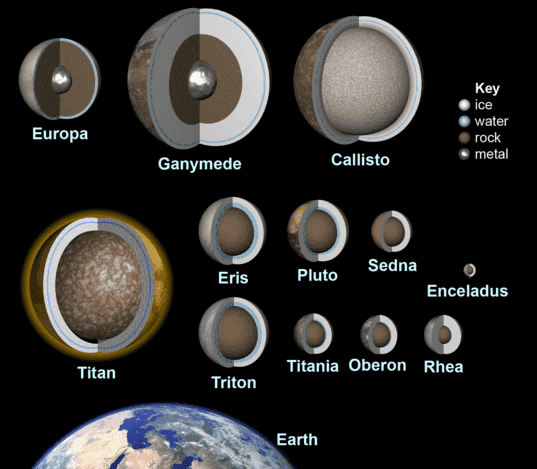
http://www.planetary.org/blogs/emily-lakdawalla/2015/03121716-ganymede-ocean.html
oceans.png

It's interesting how they infer ice layer from rotation rate and outer shape and density.
And then solve some equations to see if (within the ice layer) there could be a liquid ocean of a certain depth below surface, a certain salinity etc. Heating by tidal friction matters, of course.

Ceres is estimated to have an icy mantel something like 100 km thick (under a thin rubble crust) but no layer of ocean. It orbits the Sun by itself and isn't subject to tidal heating.

The ice mantle inference goes like this. Determine the size by inspection and the mass by observing interaction with other objects. If the density is substantially less than rock and it looks compact then there's water in its composition---calculate how much.
Now the question is, is it ice mixed with rock etc, or is it DIFFERENTIATED into layers.

That question is answered by comparing the FIGURE or shape (how flattened or oblate the ball is) with how fast it is rotating. The less differentiated, the more mass is farther out from the axis, experiencing more centrifugal force. The faster the spin, and the less differentiated, the more oblate, i.e. the more bulge at the equator.
So if it is spinning relatively fast and still not terribly oblate, it must be differentiated.
 
  • Like
Likes   Reactions: OmCheeto
Astronomy news on Phys.org
Interesting.

Raises one question with me and that is, how could one infer salinity in a sub-surface ocean? Is there some reason oceans are always assumed to be saline to one degree or another?
 
Have to see how Emily handles it. As I understand it, she has to present different cases. If this much salinity then you have this much ocean, soandso deep. I recall her presenting three cases: salinity A, B, C and each case has a different amount and depth of ocean. Because different melting point.
 
phinds said:
how could one infer salinity in a sub-surface ocean?
It's somewhat easier with Enceladeus:
http://www.nature.com/nature/journal/v519/n7542/full/nature14262.html
Detection of sodium-salt-rich ice grains emitted from the plume of the Saturnian moon Enceladus suggests that the grains formed as frozen droplets from a liquid water reservoir that is, or has been, in contact with rock
 
Last edited by a moderator:
Salinity in oceans on Earth is due to leaching of salts from rock. It appears reasonable to presume the same thing occurs on other worlds where liquid water exists.
 
Chronos said:
Salinity in oceans on Earth is due to leaching of salts from rock. It appears reasonable to presume the same thing occurs on other worlds where liquid water exists.
The layer of liquid water could be insulated from rock by a layer of ice.
 
Agreed, but, ice melts under pressure via a phenomenon known as regelation. Tidal heating would also tend to increase the temperature at the crust-ice interface.
 
Chronos said:
Salinity in oceans on Earth is due to leaching of salts from rock. It appears reasonable to presume the same thing occurs on other worlds where liquid water exists.
Good point. Thanks.
 
  • #10
Bandersnatch said:
The layer of liquid water could be insulated from rock by a layer of ice.
But it seems reasonable to me (based entirely on ignorance) that it would be safe to assume that earlier in the life of those bodies they were warmer and the water might have been liquid all the way up and down.
 

Similar threads

  • · Replies 10 ·
Replies
10
Views
5K
  • · Replies 21 ·
Replies
21
Views
6K
Replies
22
Views
4K
  • · Replies 6 ·
Replies
6
Views
4K
  • · Replies 19 ·
Replies
19
Views
6K
  • · Replies 1 ·
Replies
1
Views
6K
  • · Replies 1 ·
Replies
1
Views
4K
  • · Replies 33 ·
2
Replies
33
Views
19K
  • · Replies 18 ·
Replies
18
Views
7K
  • · Replies 2 ·
Replies
2
Views
4K