Coin
- 564
- 1
"Identifying" tiles in hyperbolic space?
So I have a software project I've been working on on and off that involves the hyperbolic plane. There is something I am stuck on:
So let's say I have filled the hyperbolic plane with one of the tilings of regular n-gons. I now would like to "label" each individual tile with some sort of number or string which uniquely identifies it, in some pattern such that if I know a particular tile's "label" I can calculate the labels of the tiles which adjoin it.
So by analogy let's say this were the euclidean plane, and I had tiled it with squares:
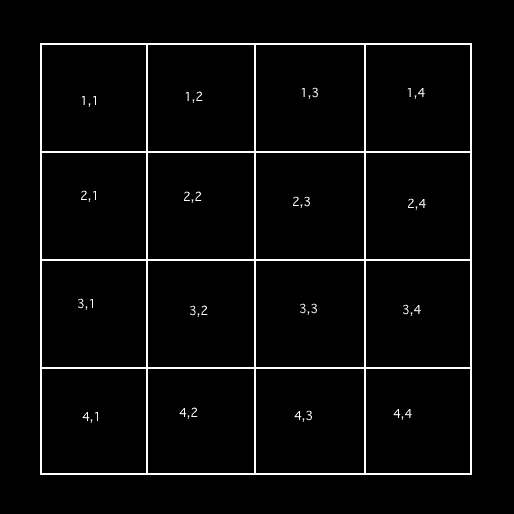
In this case labeling is easy, my "label" is each square's coordinates (x,y), such that the square labeled (x,y) is bordered by (x-1,y),(x,y-1),(x+1,y) and (x,y+1).
When I am on the hyperbolic plane, it's less obvious to me how this would work and there doesn't seem to be a natural notion of integer "coordinates". I'm looking for a tiling that would look something like:
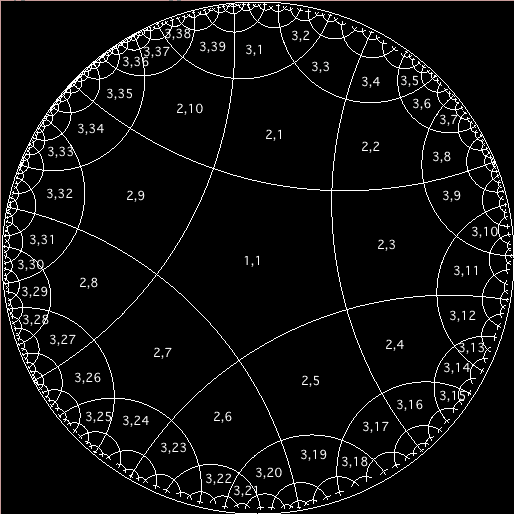
This is an ad hoc labeling (I made it in a graphics program, and I made one mistake...) for the "5,4" tiling, based around a sort of "polar" scheme where I tile one tile 1,1 and number "rings" out from that center with coordinates (r,t) with "r" being the ring number and "t" just being assigned around the circle. However this is just an example and doesn't actually help for my purposes unless I can look at the label (2,3) and somehow have a rule for deducing from the label that that tile is bordered by (1,1), (2,2), (3,9), (3,11) and (2,4).
Does anyone have any suggestions how to proceed? There seems to be a lot of information out there about these tilings in terms of what they mean in hyperbolic geometry, but less information about their discrete structure, and it's the discrete structure I'm interested in here.
Thanks.
So I have a software project I've been working on on and off that involves the hyperbolic plane. There is something I am stuck on:
So let's say I have filled the hyperbolic plane with one of the tilings of regular n-gons. I now would like to "label" each individual tile with some sort of number or string which uniquely identifies it, in some pattern such that if I know a particular tile's "label" I can calculate the labels of the tiles which adjoin it.
So by analogy let's say this were the euclidean plane, and I had tiled it with squares:
In this case labeling is easy, my "label" is each square's coordinates (x,y), such that the square labeled (x,y) is bordered by (x-1,y),(x,y-1),(x+1,y) and (x,y+1).
When I am on the hyperbolic plane, it's less obvious to me how this would work and there doesn't seem to be a natural notion of integer "coordinates". I'm looking for a tiling that would look something like:
This is an ad hoc labeling (I made it in a graphics program, and I made one mistake...) for the "5,4" tiling, based around a sort of "polar" scheme where I tile one tile 1,1 and number "rings" out from that center with coordinates (r,t) with "r" being the ring number and "t" just being assigned around the circle. However this is just an example and doesn't actually help for my purposes unless I can look at the label (2,3) and somehow have a rule for deducing from the label that that tile is bordered by (1,1), (2,2), (3,9), (3,11) and (2,4).
Does anyone have any suggestions how to proceed? There seems to be a lot of information out there about these tilings in terms of what they mean in hyperbolic geometry, but less information about their discrete structure, and it's the discrete structure I'm interested in here.
Thanks.
Last edited: