Identifying Wave-guide modes in rectangular wave guides

Click For Summary
To identify wave-guide modes in rectangular waveguides, it is essential to understand the indices m and n, which represent the number of half wavelengths in the x and y directions, respectively. The discussion highlights the distinction between TE (Transverse Electric) and TM (Transverse Magnetic) modes, specifically mentioning modes like TE01, TE10, TM11, TE02, and TE20. It clarifies that the first index indicates circumferential variations while the second index indicates radial variations, particularly in circular waveguides. The provided diagram only shows z-axis and radial variations, missing the circumferential field variations present in modes like TM11. A better reference for understanding these concepts is suggested to enhance clarity.
reddvoid
Messages
118
Reaction score
1
How to identify type of wave-guide mode here, like its TE or TM
TE01 , TE10, TM11, TE02, TE20 . ..
I read number of half wavelengths in x direction is the m and number of half-wavelengths in y direction is n. . .but I can't figure-out how . . .can somebody please explain
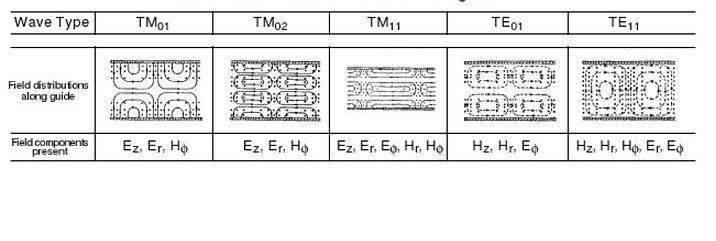
attachment.php?attachmentid=55175&stc=1&d=1359489782.jpg
 

Attachments

  • wguide.JPG
    wguide.JPG
    27.1 KB · Views: 1,529
Last edited:
Engineering news on Phys.org
Try to find a better reference. I'm sure there must be some on the "net".

You are describing circular waveguide modes.
The first index denotes the number of variations circumferentially, the second index denotes the number of variations radially.

Your diagram shows the waveguide viewed from the side, only z-axis and radial variations are visible.

The TM11 guide will have variation in fields circumferentially, which is not visible in your diagram. The diagram is a view only at one specific rotational orientation.
 
Thread 'I thought it was only Amazon that sold unsafe junk'
I grabbed an under cabinet LED light today at a big box store. Nothing special. 18 inches in length and made to plug several lights together. Here is a pic of the power cord: The drawing on the box led me to believe that it would accept a standard IEC cord which surprised me. But it's a variation of it. I didn't try it, but I would assume you could plug a standard IEC cord into this and have a double male cord AKA suicide cord. And to boot, it's likely going to reverse the hot and...

Similar threads

Replies
3
Views
2K
  • · Replies 4 ·
Replies
4
Views
9K
Replies
2
Views
2K
  • · Replies 0 ·
Replies
0
Views
1K
  • · Replies 6 ·
Replies
6
Views
3K
  • · Replies 1 ·
Replies
1
Views
2K
  • · Replies 23 ·
Replies
23
Views
8K
Replies
1
Views
2K
  • · Replies 1 ·
Replies
1
Views
2K
  • · Replies 4 ·
Replies
4
Views
18K