Identity Theorem for power series

  • Context: High School 
  • Thread starter Thread starter Hill
  • Start date Start date
  • Tags Tags
    Identity Power Proof
Click For Summary
SUMMARY

The discussion centers on the validity of a proof related to the Identity Theorem for power series. Participants highlight that the proof's assumption of dividing by ##z##, while excluding ##z=0##, leads to a flawed argument. They emphasize that the theorem holds true even if two series are equal only on an infinite sequence of points converging to ##0##. Furthermore, continuity at ##0## must be established, typically proven by demonstrating uniform convergence of power series on compact subsets within their radius of convergence.

PREREQUISITES
  • Understanding of power series and their convergence properties.
  • Familiarity with the Identity Theorem in complex analysis.
  • Knowledge of limits and ε-δ definitions in calculus.
  • Concept of uniform convergence and its implications for continuity.
NEXT STEPS
  • Study the Identity Theorem for power series in complex analysis.
  • Learn about uniform convergence and its role in the continuity of functions defined by power series.
  • Explore the implications of limits in the context of power series and their coefficients.
  • Investigate the conditions under which power series converge uniformly on compact subsets.
USEFUL FOR

Mathematicians, students of complex analysis, and anyone interested in the properties and proofs related to power series and their convergence behavior.

Hill
Messages
765
Reaction score
598
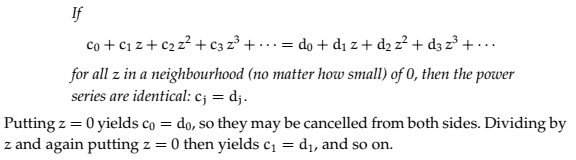
Consider this proof:
1714866541561.png

Is it a valid proof?

When we divide by ##z##, we assume that ##z \neq 0##. So, we cannot put ##z=0## on the next step. IOW, after dividing by ##z## we only know that $$c_1+c_2z+c_3z^2+...=d_1+d_2z+d_3z^2+...$$ in a neighborhood of ##0## excluding ##0##.
 
Last edited:
  • Like
Likes   Reactions: PeroK
Physics news on Phys.org
We know that ##\sum_{j=0}^\infty c_jz^j=\sum_{j=0}^\infty d_jz^j ## for all ##z\in U(0)## in a neighrhood of ##0.## By the argument you posted, we see that ##c_0=d_0## and therefore that
$$
\sum_{j=1}^\infty c_jz^{j-1}=\sum_{j=1}^\infty d_jz^{j-1}\quad \forall\,z\in U(0)-\{0\}
$$
Therefore,
$$
c_1=\lim_{z \to 0}\sum_{j=1}^\infty c_jz^{j-1}=\lim_{z \to 0} \sum_{j=1}^\infty d_jz^{j-1}=d_1\quad \forall\,z\in U(0)-\{0\}
$$
 
  • Like
Likes   Reactions: PeroK
fresh_42 said:
We know that ##\sum_{j=0}^\infty c_jz^j=\sum_{j=0}^\infty d_jz^j ## for all ##z\in U(0)## in a neighrhood of ##0.## By the argument you posted, we see that ##c_0=d_0## and therefore that
$$
\sum_{j=1}^\infty c_jz^{j-1}=\sum_{j=1}^\infty d_jz^{j-1}\quad \forall\,z\in U(0)-\{0\}
$$
Therefore,
$$
c_1=\lim_{z \to 0}\sum_{j=1}^\infty c_jz^{j-1}=\lim_{z \to 0} \sum_{j=1}^\infty d_jz^{j-1}=d_1\quad \forall\,z\in U(0)-\{0\}
$$
Yes, of course. I don't doubt the theorem. I question the quoted proof.
 
Hill said:
Yes, of course. I don't doubt the theorem. I question the quoted proof.
I think it is only sloppy. My argument with the limits works because the functions are analytical (per construction) and therefore continuous, and the equation holds in ##\{0\},## too, because it is a limit point.
 
  • Like
Likes   Reactions: PeroK
fresh_42 said:
I think it is only sloppy. My argument with the limits works because the functions are analytical (per construction) and therefore continuous, and the equation holds in ##\{0\},## too, because it is a limit point.
Your argument works, undoubtfully. The quoted proof, OTOH, would fail a high school exam, I think.
 
The theorem holds even if the two series are equal only on an infinite sequence of points converging to ##0##.
 
Math problems with the word "neighborhood" make my brain instantly think of limits and ε-δ arguments. It is common, albeit sometimes sloppy, shorthand for people to say ##z=0## when they really mean ##\lim_{z \rightarrow 0}##.
 
I agree, but in this case the author seems to mean actually putting ##z=0##, because a bit later, when talking about strengthening this result, he says,
The verification is essentially the same, only instead of putting z = 0, we now take the limit as z approaches 0, either along the segment of curve or through the sequence of points.
 
Hill said:
Consider this proof:
View attachment 344552
Is it a valid proof?

When we divide by ##z##, we assume that ##z \neq 0##. So, we cannot put ##z=0## on the next step. IOW, after dividing by ##z## we only know that $$c_1+c_2z+c_3z^2+...=d_1+d_2z+d_3z^2+...$$ in a neighborhood of ##0## excluding ##0##.
The fact is true, so any "proof", no matter how weak, might seem valid. But that "proof" never uses their equality in the neighborhood, so you should be skeptical. Try applying that "proof" to ##f(z) \equiv 0## and ##g(z) = z## at ##z=0##.
 
  • Like
Likes   Reactions: PeroK and Hill
  • #10
Just to add something simple but useful. The proposition is identical to saying that if, for all ##z## in a neighbourhood of 0, we have:
$$c_0 + c_1z + c_2z^2 +c_3z^3 \dots = 0$$Then all the coefficients are zero.

And, as any neighbourhood of zero contains a real, open interval of zero, then the result follows immediately from the real case.
 
  • Like
Likes   Reactions: weirdoguy, docnet and FactChecker
  • #11
fresh_42 said:
We know that ##\sum_{j=0}^\infty c_jz^j=\sum_{j=0}^\infty d_jz^j ## for all ##z\in U(0)## in a neighrhood of ##0.## By the argument you posted, we see that ##c_0=d_0## and therefore that
$$
\sum_{j=1}^\infty c_jz^{j-1}=\sum_{j=1}^\infty d_jz^{j-1}\quad \forall\,z\in U(0)-\{0\}
$$
Therefore,
$$
c_1=\lim_{z \to 0}\sum_{j=1}^\infty c_jz^{j-1}=\lim_{z \to 0} \sum_{j=1}^\infty d_jz^{j-1}=d_1\quad \forall\,z\in U(0)-\{0\}
$$
For this to work, the functions defined by the power series must be continuous at ##0##, as you pointed out in a later post. This continuity needs to be proved, and this is done by using the property that a power series converges uniformly on compact subsets inside its circle of convergence (or is there another way to prove that?). So to be complete, the OP's book should have dealt with these issues before the theorem quoted.
 
  • Like
Likes   Reactions: PeroK

Similar threads

  • · Replies 8 ·
Replies
8
Views
3K
  • · Replies 5 ·
Replies
5
Views
3K
  • · Replies 3 ·
Replies
3
Views
3K
  • · Replies 11 ·
Replies
11
Views
3K
  • · Replies 5 ·
Replies
5
Views
3K
  • · Replies 4 ·
Replies
4
Views
2K
  • · Replies 1 ·
Replies
1
Views
1K
  • · Replies 2 ·
Replies
2
Views
3K
  • · Replies 1 ·
Replies
1
Views
3K
  • · Replies 12 ·
Replies
12
Views
3K