Discussion Overview
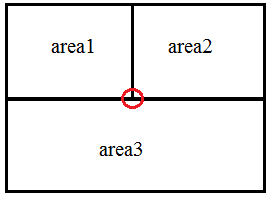
The discussion centers on implementing boundary conditions in the Finite Difference Method (FDM) for magnetic field intensity at a specific node, referred to as the "red point." Participants explore various approaches to satisfy continuity conditions for the magnetic field components at this node, while addressing the complexities introduced by multiple regions with different material properties and boundary conditions.
Discussion Character
- Technical explanation
- Debate/contested
- Mathematical reasoning
Main Points Raised
- One participant expresses confusion about finding a single equation to satisfy the continuity of both $H_x$ and $H_y$ components at the red point.
- Another participant suggests using interpolation to express the field at a point between the intersection and the closest sample point along the boundary, applying boundary conditions to this interpolated point.
- A participant presents an equation based on Ampere's circuit law for the singular node and seeks feedback on its correctness and formulation of the interpolation equation.
- Questions are raised about the specific boundary conditions applied at the outer boundary and the equations governing the regions away from boundaries.
- One participant outlines the equations governing different areas, including a nonhomogeneous function due to a permanent magnet, and specifies Dirichlet and symmetry conditions for the outer edges.
- Another participant recalls a similar 2D problem and recommends centering the grid at interior boundaries and using interpolation between regions of continuous quantities.
- A participant inquires about the formulation of linear interpolation and its relation to the Laplace equation, expressing concern about achieving accurate derivatives at the interfaces.
- Discussion includes the clarification that the Laplace equation is valid only at interior nodes and that boundary conditions must be applied to express values in terms of interior points.
- Participants discuss the potential differences between linear interpolation and the discrete Laplace equation, noting that not all second derivatives exist at the boundary.
Areas of Agreement / Disagreement
Participants do not reach a consensus on the correct approach to implement the boundary conditions at the red point. Multiple competing views and methods are presented, and the discussion remains unresolved regarding the best formulation and application of boundary conditions.
Contextual Notes
Limitations include the dependence on specific assumptions about the continuity of derivatives across boundaries and the need for clarity on the nature of the boundary conditions applied. The discussion also highlights the complexity introduced by different material properties in the regions involved.