Improving 3 Digit Number Solutions

  • Context:
  • Thread starter Thread starter Ilikebugs
  • Start date Start date
Join the discussion
Ask a follow-up here, or get your own question answered by working scientists, mathematicians and engineers — people, not an autocomplete.
Real named experts · corrections over time · the nuance an AI answer skips
10 replies · 2K views
Ilikebugs
Messages
94
Reaction score
0
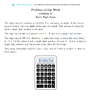
View attachment 6241 Is there a better way than guess and check? Also is there a way for a 3 digit number to get to 3 steps, because 999 only goes to 2.
 

Attachments

  • POTW D D.png
    POTW D D.png
    30.2 KB · Views: 145
Mathematics news on Phys.org
Let's denote the "digit sum" function by $\text{D}_{\text{S}}$. After computing this function for the first several natural numbers $n\in\mathbb{N}$ such that $\text{D}_{\text{S}}(n)=5$, I wish to put forth the hypothesis:

$$\text{D}_{\text{S}}(n+9)=\text{D}_{\text{S}}(n)$$.

Let's try to prove this...let's begin by letting $n$ have $m$ digits...thus:

$$n=\sum_{k=0}^{m-1}\left(a_{k}10^{k}\right)$$ where $0\le a_k\le9$ and $0<a_{m-1}$.

We can see that we must have:

$$\text{D}_{\text{S}}(n)=\text{D}_{\text{S}}\left(\sum_{k=0}^{m-1}\left(a_{k}\right)\right)$$

Let's first examine the case where $0<a_0$...what happens to $a_0$ and $a_1$ when we add $9$ to $n$?
 
the digit sum is the same?
 
Ilikebugs said:
the digit sum is the same?

That's the hypothesis we're trying to prove.

What I'm asking is when the one's digit for $n$ is not zero, what happens to the one's digit and the ten's digit when we add 9 to $n$?
 
The ones digit is subtracted by 1 and the tens digit is added by 1
 
Ilikebugs said:
The ones digit is subtracted by 1 and the tens digit is added by 1

Correct! :D

So this leave the digit sum unchanged. What about if $n$ ends in one or more zeroes? What can we do then? (Thinking)
 
MarkFL said:
Correct! :D

So this leave the digit sum unchanged. What about if $n$ ends in one or more zeroes? What can we do then? (Thinking)

Hint: The commutative property of addition...(Thinking)
 
Okay, let's assume the lemma I gave is true, and so all numbers having at least 3 digits and whose digit sum is 5 is given by:

$n=95+9m$ where $m\in\mathbb{N}$

We find the largest 3 digit number whose digit sum is 5 to be 995. So we set:

$n=95+9m=995$

$$9m=900$$

$$m=100$$

Thus, there are 100 such numbers for which the question called. And you are correct that all can be found in less than 3 steps.
 
Alternatively, observe that the digit sum for consecutive numbers increases by 1 as we add 1, "rolling over" to 1 as we increase by one from a digit sum of 9. Since 999 - 99 = 900 and 900/9 = 100, there are 100 numbers in the given range with a digit sum of 5.
 
greg1313 said:
Alternatively, observe that the digit sum for consecutive numbers increases by 1 as we add 1, "rolling over" to 1 as we increase by one from a digit sum of 9. Since 999 - 99 = 900 and 900/9 = 100, there are 100 numbers in the given range with a digit sum of 5.

Greg, I'm just curious, had you ever heard of "digit sums" before this thread? I hadn't. It seems a topic for a rich exploration. :D
 
MarkFL said:
Greg, I'm just curious, had you ever heard of "digit sums" before this thread? I hadn't. It seems a topic for a rich exploration. :D

Yes. Actually they appear in number theory and discrete mathematics (at least). I once used digit sums to solve a problem that involved finding the missing digits in a sum. I don't recall the exact problem; it was quite some time ago. :)