Impulse question: throwing a rock

  • Thread starter Thread starter Morange
  • Start date Start date
  • Tags Tags
    Impulse Rock
Join the discussion
Ask a follow-up here, or get your own question answered by working scientists, mathematicians and engineers — people, not an autocomplete.
Real named experts · corrections over time · the nuance an AI answer skips
4 replies · 3K views
Morange
Messages
2
Reaction score
0
Hello,

Homework Statement


You throw a 0.500 kg rock underhand, as shown in the diagram. The rock starts at rest from the lowest point moving at an angle of 40° above the horizontal, and leaves your hand 0.300 s later having traveled 1.20 m. What is the average force that you exert on the ball while it is in your hand?
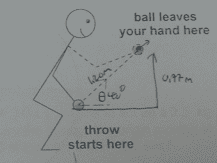
GRabT8m.png


Homework Equations


[itex]\vec{F}[/itex]=[itex]\frac{∆P}{∆t}[/itex]


The Attempt at a Solution


I tried to sub the values straight in but not sure now to incorporate the force of gravity. Also I used the average speed for ∆P

F = 0.500kg*(1.2m/0.300s)/0.300s = 6.67 N
 
Last edited:
Physics news on Phys.org
Gravity will give an additional ∆P you can include in your calculation.

Also I used the average speed for ∆P
That looks wrong.

I think you have to assume a uniform acceleration here (that should be given - without that, it is not possible to calculate the average force).
 
By average force the question means the minimum force for the object to leave your hand? I didn't quite get the final data, like, where's the object land? By the data that you show I'm not show how to calculate this. Are there more date to the problem?
 
This was all the data given. I think I have it:

I found the acceleration using the kinematics equation

∆d = t*V1 + 1/2*a*t^2

in which ∆d = 1.2, V1 = 0, and t = 0.300s

1.2m = 0.300s*(0 m/s) + 1/2a(0.300)^2
then the a turns out to be 26.666 m/s

Then I broke the acceleration into x,y components
a(x) = 26.6666*cos(40) = 20.427
a(y) = 26.6666*sin(40) = 17.141

Then I calculated the net force for each component using F = m*a, m = 0.500kg
Fnet(x) = F(x, applied)
= 20.427m/s^2 * 0.500 kg
= 10.21 N

Fnet(y) =
F(y, applied) - Fg
= 17.141 m/s^2 *0.500 kg
= 8.57 N

Since the vertical component of net force is the sum of gravity and the applied force I add the force of gravity to the vertical net force
8.57 N + mg = 8.57 N + (0.500)(9.8) = 13.47 N

Now that I have the horizontal and vertical applied forces I used pythagorean theorem to figure out the applied force
F(applied) = [itex]\sqrt{13.47^2+10.21^2}[/itex]
= 16.9 N

Now I question I have is why is 16.9 N the average force AND the applied force? Is it due to it being constant force?
 
With the assumptions made in your derivation, it is a constant force, and the average of a constant value is always this constant value.

As I wrote before, you have to make an assumption about the acceleration process to get a result (--> bad problem statement), so a constant acceleration (and therefore a constant force) is the most reasonable choice.