Inclined Plane Vector Problem: Understanding the Use of Trigonometric Functions

Click For Summary
SUMMARY

The discussion centers on the application of trigonometric functions, specifically sine and cosine, in resolving forces acting on an inclined plane at a 30-degree angle. Participants clarify that weight is indeed constant, but its components along the ramp (x-axis) and perpendicular to the ramp (y-axis) are determined using these trigonometric functions. The angle of friction is considered zero in this context since the surface is straight. Proper identification of coordinate systems is essential for accurate force analysis.

PREREQUISITES
  • Understanding of basic trigonometric functions (sine and cosine).
  • Familiarity with inclined plane physics concepts.
  • Knowledge of force resolution in two dimensions.
  • Basic understanding of friction and its role in physics problems.
NEXT STEPS
  • Study the principles of force resolution using trigonometric functions.
  • Learn about inclined plane problems in classical mechanics.
  • Explore the concept of friction and its coefficients in physics.
  • Investigate coordinate systems and their applications in physics problems.
USEFUL FOR

Students of physics, educators teaching mechanics, and anyone seeking to understand the application of trigonometric functions in force analysis on inclined planes.

Ineedhelpwithphysics
Messages
43
Reaction score
7
Homework Statement
In picture
Relevant Equations
Cos(x), sin(x), angle addition/subtraction.
I'm not really asking for a solution for this problem I just want to clear up a confusion I have.

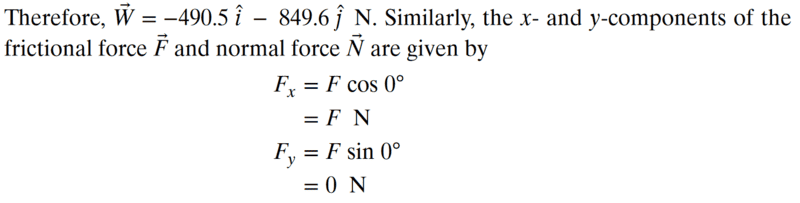
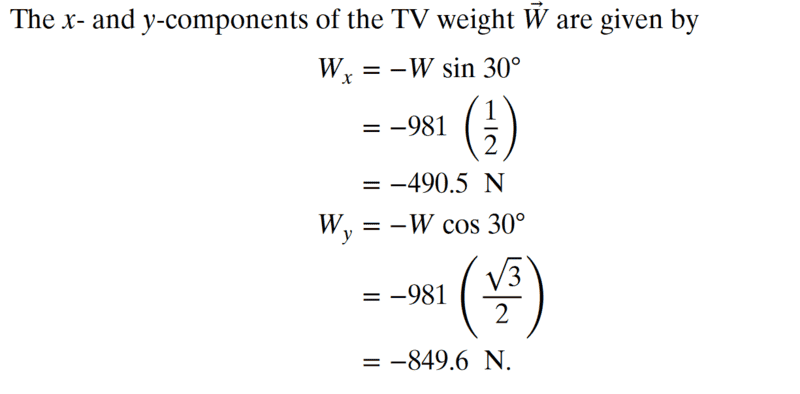
Why are they multiplying the weight by the sin and cosine of the 30-degree angle?
Isn't weight not affected by anything since it's constant?

Also is the angle of friction 0 because it's a straight line?
Screenshot 2023-10-20 154330.png

Screenshot 2023-10-20 154407.png
Screenshot 2023-10-20 154348.png
 
Physics news on Phys.org
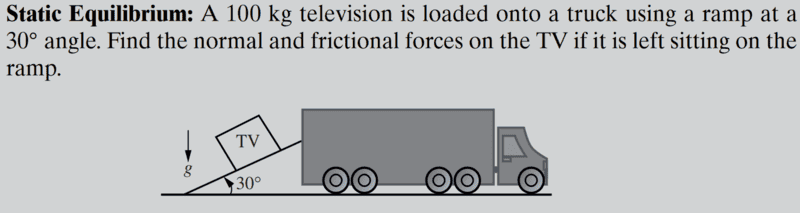
Did you post the entire question and solution? It should state that the coordinates chosen are parallel to the ramp (x) and normal to the ramp (y). The use of sin and cos is to find the components of the weight in those directions.
 
haruspex said:
Did you post the entire question and solution? It should state that the coordinates chosen are parallel to the ramp (x) and normal to the ramp (y). The use of sin and cos is to find the components of the weight in those directions.
1697845376188.png

sorry about that
 

Similar threads

Replies
8
Views
3K
  • · Replies 5 ·
Replies
5
Views
2K
  • · Replies 24 ·
Replies
24
Views
2K
  • · Replies 3 ·
Replies
3
Views
2K
  • · Replies 5 ·
Replies
5
Views
2K
  • · Replies 2 ·
Replies
2
Views
3K
  • · Replies 5 ·
Replies
5
Views
2K
  • · Replies 3 ·
Replies
3
Views
5K
Replies
3
Views
2K
  • · Replies 3 ·
Replies
3
Views
1K