mathmari
Gold Member
MHB
- 4,984
- 7
Hey! 
A square with the side length $2^n$ length units (LU) is divided in sub-squares with the side length $1$. One of the sub-squares in the corners has been removed. All other sub-squares should now be covered completely and without overlapping with L-stones. An L-stone consists of three sub-squares that together form an L.
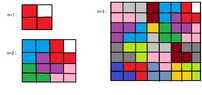
I want to draw the problem for the first three cases described above ($1 \leq n \leq 3$). Then I want to show the following using induction:
For all $n \in N$ the square with side length $2^n$ LU can be covered completely and without overlapping with L-stones, after one of the sub-squares in the corners has been removed.
For the first part:
View attachment 9354
Is the drawing correct? (Wondering)
A square with the side length $2^n$ length units (LU) is divided in sub-squares with the side length $1$. One of the sub-squares in the corners has been removed. All other sub-squares should now be covered completely and without overlapping with L-stones. An L-stone consists of three sub-squares that together form an L.
I want to draw the problem for the first three cases described above ($1 \leq n \leq 3$). Then I want to show the following using induction:
For all $n \in N$ the square with side length $2^n$ LU can be covered completely and without overlapping with L-stones, after one of the sub-squares in the corners has been removed.
For the first part:
View attachment 9354
Is the drawing correct? (Wondering)
Attachments
Last edited by a moderator: