Inelastic Collision At An Angle

Click For Summary

Homework Help Overview

The discussion revolves around an inelastic collision involving two objects of equal mass traveling at an angle relative to the x-axis. After the collision, they combine into a single object moving horizontally, and the participants are tasked with finding the angle θ in radians.

Discussion Character

  • Exploratory, Assumption checking, Mathematical reasoning

Approaches and Questions Raised

  • The original poster attempts to apply the conservation of momentum but expresses uncertainty about their approach. Participants discuss the total momentum before and after the collision, emphasizing the vector nature of momentum.

Discussion Status

Participants are actively engaging with the problem, with one providing a response that encourages the use of conservation of momentum. There is an exploration of the momentum calculations before and after the collision, but no consensus or resolution has been reached yet.

Contextual Notes

There is a mention of the problem being from a practice exam, indicating a structured context for the discussion. The participants are also navigating the implications of treating velocities as vectors in their momentum calculations.

Saendy
Messages
2
Reaction score
0
Two objects of mass M (= 1 kg) each travel with identical speed (|v1| = |v2| = 3 m/s) making an angle of θ relative to the x-axis. After they collide with each other, they travel as one object of mass 2M and with a velocity v3 (|v3| = 2 m/s) in the horizontal direction.
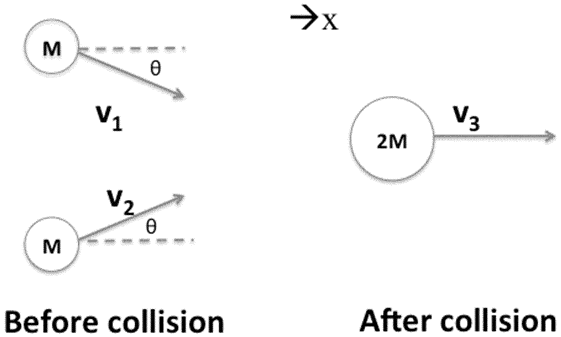
fig1.gif


What is the value for angle θ in radians?

I tried m1 * v1 * cos(θ) + m2 * v2 * cos(θ) = mf * vf, but that was just a blind attempt to try something.

It's a practice exam question so I know the answer, but I want to know how to get there.
 
Physics news on Phys.org
Saendy said:
Two objects of mass M (= 1 kg) each travel with identical speed (|v1| = |v2| = 3 m/s) making an angle of θ relative to the x-axis. After they collide with each other, they travel as one object of mass 2M and with a velocity v3 (|v3| = 2 m/s) in the horizontal direction.

fig1.gif


What is the value for angle θ in radians?

I tried m1 * v1 * cos(θ) + m2 * v2 * cos(θ) = mf * vf, but that was just a blind attempt to try something.

It's a practice exam question so I know the answer, but I want to know how to get there.
Hello Saendy. Welcome to PF !

Use conservation of momentum.

What's the momentum of the system (total momentum) before the collision?

What's the momentum of the system after the collision?
 
Last edited:
Hi Sammy, thanks for replying!

The total momentum before should be:

Pi = (m1 * v1) + (m2 * v2) = (3*1) + (3*1) = 6

The total momentum after should be:

Pf = (2m * vf) = (2*2) = 4
 
Saendy said:
Hi Sammy, thanks for replying!

The total momentum before should be:

Pi = (m1 * v1) + (m2 * v2) = (3*1) + (3*1) = 6
Don't forget v1 andv2 are vectors. Momentum is too.

The total momentum after should be:

Pf = (2m * vf) = (2*2) = 4
 

Similar threads

  • · Replies 4 ·
Replies
4
Views
2K
Replies
3
Views
2K
  • · Replies 15 ·
Replies
15
Views
2K
  • · Replies 7 ·
Replies
7
Views
2K
  • · Replies 1 ·
Replies
1
Views
2K
Replies
9
Views
3K
  • · Replies 8 ·
Replies
8
Views
2K
Replies
5
Views
3K
Replies
3
Views
1K
  • · Replies 6 ·
Replies
6
Views
2K