Inelastic Collision of an object Problem

Click For Summary
In a perfectly inelastic collision, a 1.5 kg object moving at 14 m/s collides with a stationary 2.0 kg object, requiring the calculation of the combined system's velocity before ascending an incline. The discussion emphasizes using conservation of momentum to determine this velocity, followed by analyzing forces acting on the system to find the distance traveled up the slope. Participants mention the need to equate kinetic energy to potential energy to solve for height, then apply trigonometry to find the distance moved. One user confirms they solved the problem with the help of others in the thread. The conversation highlights collaborative problem-solving in physics related to inelastic collisions and motion on an incline.
fire765
Messages
4
Reaction score
0
A m=1.5 kg object moving at 14 m/s collides with a stationary 2.0 kg object. If the collision is perfectly inelastic, how far along the inclined plane will the combined system travel? Neglect Friction.
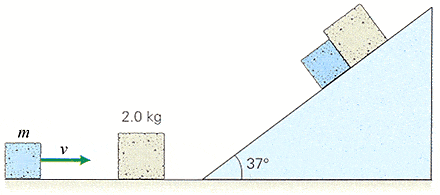
6-38alt.gif


Any help would be appreciated
 
Physics news on Phys.org
This is a three part question. First you need to calculate the velocity of the combined mass system before it begins up the incline. Second, you need to determine what will slow the combined mass system down, and to what magnitude (free-body diagram). Then, it's simple kinematics to see how far up the slope the system will go.
 
I have the same exact problem with the incline...I think we have the same prof. Is it from the study guide on webassign?
 
Using conservation momentum find the velocity of the combined mass before it starts climbing the inclined plane. After moving certain distance along inclined plane combined blocks stop. So loss of KE = gain in PE. From this you can get the height of the combind blocks from the ground. Using the angle of inclination you can find the distance moved by the blocks.
 
complexc25 said:
I have the same exact problem with the incline...I think we have the same prof. Is it from the study guide on webassign?

yea its a group problem on webassign for my class

edit: I figured it out, thanks for the the help. find the KE (1/2mv^2) then set it equal to PE (mgh) and solve for h. then use trig to find the distance traveled. Again, thanks for the help, and there's one other problem ill be posting in a bit.
 
Last edited:
Thread 'Correct statement about size of wire to produce larger extension'
The answer is (B) but I don't really understand why. Based on formula of Young Modulus: $$x=\frac{FL}{AE}$$ The second wire made of the same material so it means they have same Young Modulus. Larger extension means larger value of ##x## so to get larger value of ##x## we can increase ##F## and ##L## and decrease ##A## I am not sure whether there is change in ##F## for first and second wire so I will just assume ##F## does not change. It leaves (B) and (C) as possible options so why is (C)...

Similar threads

  • · Replies 7 ·
Replies
7
Views
4K
Replies
9
Views
2K
  • · Replies 2 ·
Replies
2
Views
3K
  • · Replies 21 ·
Replies
21
Views
3K
  • · Replies 4 ·
Replies
4
Views
2K
  • · Replies 2 ·
Replies
2
Views
2K
  • · Replies 13 ·
Replies
13
Views
1K
  • · Replies 9 ·
Replies
9
Views
4K
  • · Replies 6 ·
Replies
6
Views
3K
Replies
3
Views
7K