Homework Help Overview
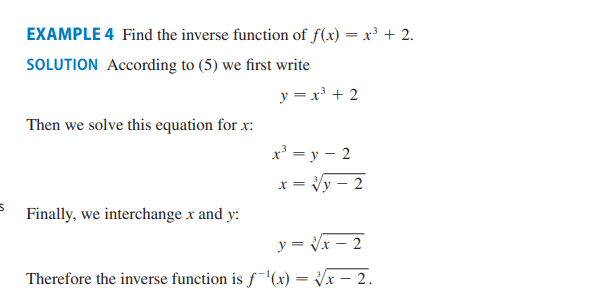
The discussion revolves around the interchange of variables x and y when dealing with inverse functions, particularly in the context of mathematical definitions and graphing. Participants explore the implications of this interchange in various scenarios, including specific functions and their inverses.
Discussion Character
- Conceptual clarification, Assumption checking, Mixed
Approaches and Questions Raised
- Participants question the validity of swapping x and y, considering the definitions of variables and the implications for graphing. Some provide examples of functions and their inverses, discussing the symmetry about the line y=x. Others emphasize the importance of defining the domain to ensure the inverse is a function.
Discussion Status
The conversation is ongoing, with various perspectives being shared. Some participants offer insights into the reasoning behind variable interchange, while others express concerns about potential confusion and the need for clarity in definitions. There is no explicit consensus, but several productive lines of reasoning are being explored.
Contextual Notes
Participants note that the domain of functions can affect the existence of inverses and that assumptions about variable definitions may vary based on context. The discussion includes references to specific functions and their properties, highlighting the need for careful consideration of domains and ranges.