Interesting Brain Scanning/Stimulating Backpack Allows Mobile Brain Studies

Click For Summary
SUMMARY

The discussion centers on a groundbreaking technology that enables mobile brain studies through a brain implant and a specialized backpack. The backpack, weighing 4 kilograms, houses monitors that facilitate real-time data collection from the neural implant, which communicates via a wand positioned near the scalp. Participants can also wear additional equipment, such as a scalp electroencephalography cap, virtual reality goggles, and devices for tracking heart and breathing rates, allowing for comprehensive synchronization of brain and body activity data. This innovative setup is detailed in the study "Wireless Programmable Recording and Stimulation of Deep Brain Activity in Freely Moving Humans" by Topalovic et al., published in Neuron.

PREREQUISITES
  • Understanding of neural implants and their functions
  • Familiarity with electroencephalography (EEG) techniques
  • Knowledge of virtual reality technology and its applications
  • Basic principles of physiological monitoring (heart rate, breathing rate)
NEXT STEPS
  • Research the implications of brain-computer interfaces (BCIs) in mobile settings
  • Explore the use of Raspberry Pi in biomedical applications
  • Investigate advancements in wireless neural communication technologies
  • Study the ethical considerations surrounding brain implant technologies
USEFUL FOR

Neuroscientists, biomedical engineers, researchers in brain-computer interfaces, and professionals interested in mobile health technologies will benefit from this discussion.

BillTre
Science Advisor
Gold Member
Messages
2,739
Reaction score
11,966
TL;DR
A backpack set-up allows brain scanning and stimulation of mobile subjects.
This new technology will make monitoring outside of labs possible.
It requires a brain implant.
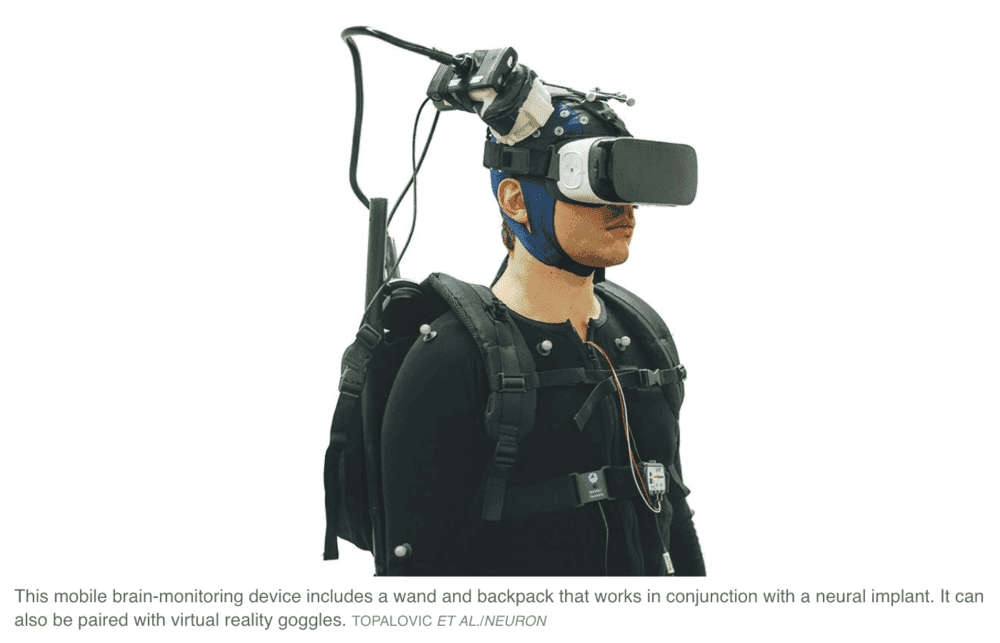
Here’s how it works: A wand snakes up out of a 4-kilogram backpack to rest near the top of the patient’s scalp. There, the wand can communicate with a neural implant that lies deep in the brain. Meanwhile, the backpack is filled with monitors—a setup that allows for real-time data collection from the implant. At the same time, depending on the experiment, the participant can wear additional gear for measuring brain and body activities, including a scalp electroencephalography cap with electrodes that monitor surface brain activity, a pair of virtual reality goggles that track eye movement, and other devices that track heart and breathing rates. All of this information can then be synchronized with signals from the implant.

Screen Shot 2020-09-19 at 5.11.37 PM.png


Kind of reminds me of the Borg.
Screen Shot 2020-09-19 at 5.14.52 PM.png
 
  • Like
  • Informative
Likes   Reactions: jim mcnamara and atyy
Biology news on Phys.org
Wireless Programmable Recording and Stimulation of Deep Brain Activity in Freely Moving Humans.
Topalovic U, Aghajan ZM, Villaroman D, Hiller S, Christov-Moore L, Wishard TJ, Stangl M, Hasulak NR, Inman CS, Fields TA, Rao VR, Eliashiv D, Fried I, Suthana N.
Neuron. 2020 Sep 15:S0896-6273(20)30652-8. doi: 10.1016/j.neuron.2020.08.021. Online ahead of print.
PMID: 32946744
https://pubmed.ncbi.nlm.nih.gov/32946744/
https://doi.org/10.1016/j.neuron.2020.08.021

Preprint: https://www.biorxiv.org/content/10.1101/2020.02.12.946434v1
 
  • Like
  • Informative
Likes   Reactions: Tom.G, jim mcnamara and BillTre
Interesting, especially that it uses a Raspberry Pi for local intelligence.
 
  • Informative
Likes   Reactions: BillTre

Similar threads

  • · Replies 3 ·
Replies
3
Views
4K
  • · Replies 4 ·
Replies
4
Views
4K