weirdoguy
- Messages
- 1,419
- Reaction score
- 1,455
Hello everyone!
So I'm working through problems from this years' polish physics olimpiad, and I have a problem with one problem (I google-translated it, hope it's not a problem):
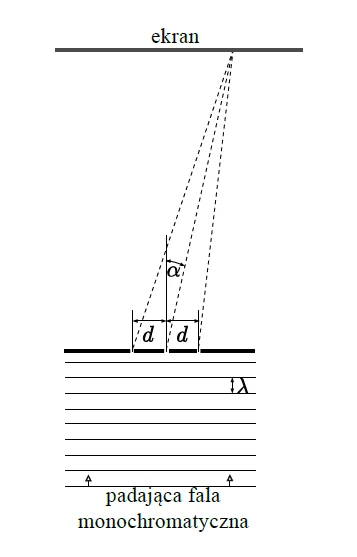
A flat wall contains three equidistant, thin slits of identical length. The distance between adjacent slits is d = 2.116 μm. The width of the central slit is w = 1.4 times greater than the other slits. A monochromatic wave with wavelength λ = 650 nm is incident perpendicularly on the partition. Interference fringes can be observed on a screen located at a distance significantly greater than d. Determine the angle at which first interference minimum is observed.
Here is the drawing:
So, authors state that the intensity of wave at the point we are interested in is proportional to:
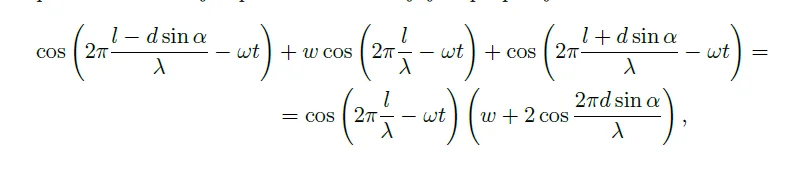
My question: is there a simple, high-school argument that there should be ##w## in there, multiplying second cosine? I found something on wikipedia, but complex exponents and all that are not a good look in high-school.
I know I should know such things as a physicists, but "waves and oscillations" were at the second year, exactly at the time when I started partying hard, so I'm not that good with waves I'm still good at partying though.
PS. Interesting that google translator changed commas to periods in numbers (we use commas in Poland, so we write 2,116 instead of 2.116).
So I'm working through problems from this years' polish physics olimpiad, and I have a problem with one problem (I google-translated it, hope it's not a problem):
A flat wall contains three equidistant, thin slits of identical length. The distance between adjacent slits is d = 2.116 μm. The width of the central slit is w = 1.4 times greater than the other slits. A monochromatic wave with wavelength λ = 650 nm is incident perpendicularly on the partition. Interference fringes can be observed on a screen located at a distance significantly greater than d. Determine the angle at which first interference minimum is observed.
Here is the drawing:
So, authors state that the intensity of wave at the point we are interested in is proportional to:
My question: is there a simple, high-school argument that there should be ##w## in there, multiplying second cosine? I found something on wikipedia, but complex exponents and all that are not a good look in high-school.
I know I should know such things as a physicists, but "waves and oscillations" were at the second year, exactly at the time when I started partying hard, so I'm not that good with waves
I'm still good at partying though.PS. Interesting that google translator changed commas to periods in numbers (we use commas in Poland, so we write 2,116 instead of 2.116).
